Western Region
HAWAI’I VOLCANOES
NATIONAL PARK
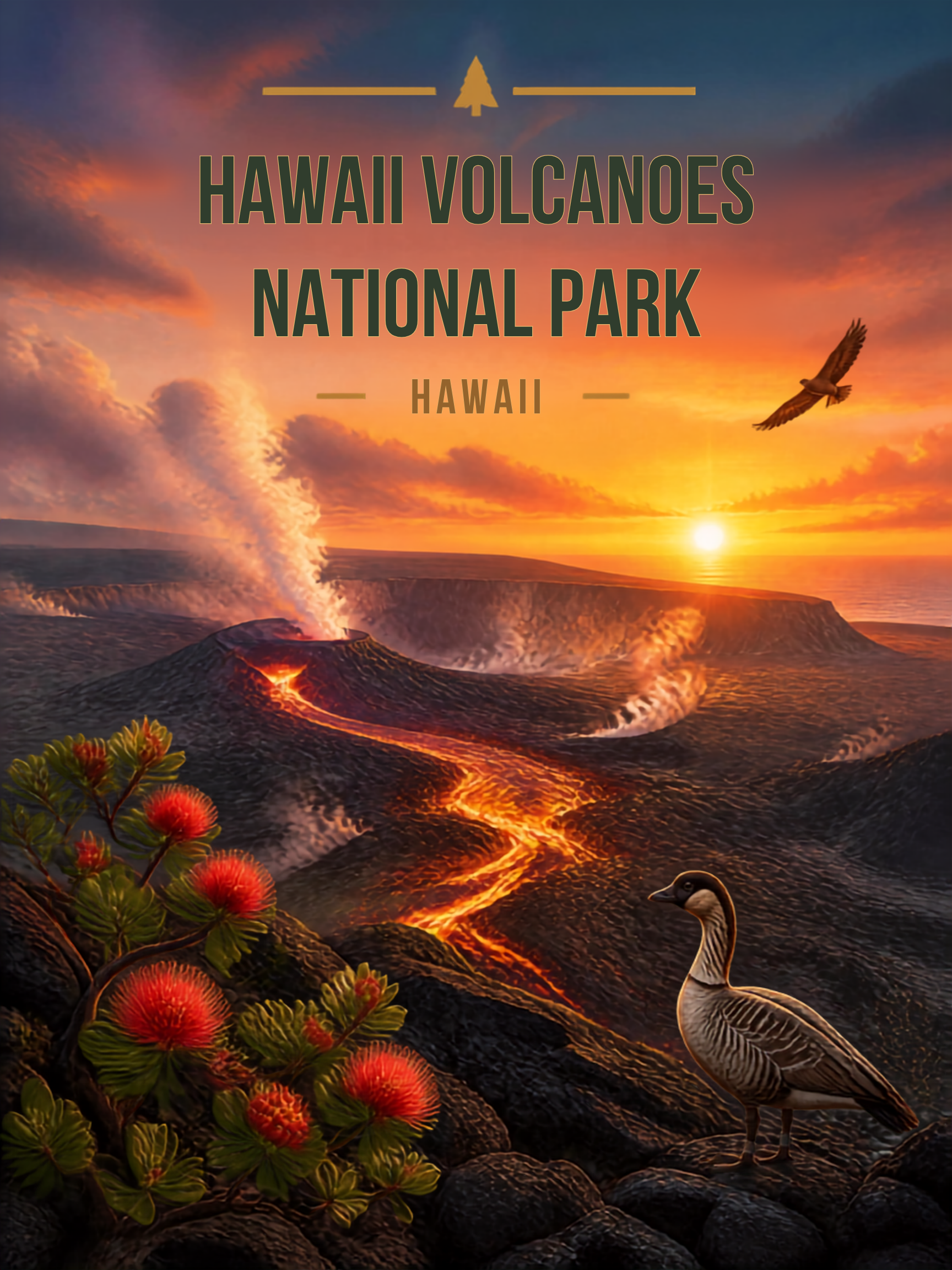
Welcome to Hawaiʻi Volcanoes National Park, a dynamic landscape of active volcanoes, diverse ecosystems, and deep cultural history located on the Big Island of Hawaiʻi. The park protects two of the world’s most famous volcanoes Kīlauea and Mauna Loa and is one of the most geologically active national parks on Earth. Visitors can explore volcanic craters, walk across hardened lava lakes, and experience the raw forces that continue to shape the Hawaiian Islands.

Did You Know?
- Mauna Loa is the largest active volcano on Earth. Measured from the ocean floor, it rises more than 33,500 feet, making it taller than Mount Everest.
- Hawaiʻi Volcanoes National Park is a UNESCO World Heritage Site.
- The park contains Halemaʻumaʻu Crater, traditionally believed to be the home of Pele, the Hawaiian goddess of fire and volcanoes.

My Personal Experience
I highly recommend visiting the park twice: once during the day and again after dark.
Hawaiʻi Volcanoes National Park is located on the Island of Hawaiʻi (the Big Island) and encompasses two active volcanoes: Kīlauea and Mauna Loa. You will need to start early if you want to make the most of your visit. The island is called the Big Island for a reason. If you stay in Hilo, it takes about 45 minutes to reach the park entrance, while from Kailua-Kona the drive can take 2.5 hours.
Always check the National Park Service website before visiting. Parts or occasionally the entire park may close due to volcanic activity.
On my first visit in 2006, the road around the Kīlauea caldera was completely open and drivable. Since then, portions have been closed or rerouted due to eruptions and geological changes.
After visiting the caldera, I drove the Chain of Craters Road all the way to the end near the Hōlei Sea Arch. The road once continued farther, but the rest has been buried by lava flows.
On my second visit, I returned at night, approaching from the east side near Pāhoa and Kalapana, to see glowing lava flows in the distance. Watching the bright red lava against the dark night sky is something you will never forget. Be sure to check with the National Park Service for current viewing areas because access can change and sometimes involves privately owned land.
Don’t underestimate the size of the park when planning your visit. And remember that Hawaiʻi is close to the equator, so bring plenty of sunscreen especially if you rent a convertible and drive with the top down. I learned that lesson the hard way during my first trip.

Basic Facts
Address:
Hawaiʻi Volcanoes National Park
PO Box 52
Hawaii National Park, HI 96718
Operation Hours and Seasons:
The park is open year-round, 24 hours a day.
Visitors:
Over 1.1 million per year (2022)
Entrance Fees:
- Private Vehicle: $30.00 (admits one private, non-commercial vehicle and all its occupants for seven days)
- Per Person: $15.00 (when entering on foot or bicycle, valid for seven days)
Website:
nps.gov/havo
Map:
nps.gov/havo/planyourvisit/maps.htm
Additional Information:
For additional local information, visit gohawaii.com.

Best Time to Visit
The best time to visit is during the shoulder seasons of spring (March–May) and fall (September–October), when the weather is pleasant and visitor numbers are lower.

Recommended Time
Driving times on the Big Island are long, so plan accordingly.
1 Day: Visit Kīlauea Caldera and drive the Chain of Craters Road.
2-3 Days: Allows time to explore more remote areas of the park and enjoy several hiking trails.

Getting There
The closest major city is Hilo. From Hilo, take HI-11 South to the park entrance

Weather
Weather conditions vary significantly across the park due to elevation changes.
- Spring (March to May): 60s–70s°F (15–21°C). Mild with occasional rain.
- Summer (June to August): 70s–80s°F (21–27°C). Warm and relatively dry.
- Fall (September to November): 60s–70s°F (15–21°C). Clear and pleasant.
- Winter (December to February): 60s–70s°F (15–21°C). Cooler with more rain.

Hiking
Hawaiʻi Volcanoes National Park offers a variety of trails across lava flows, volcanic craters, and rainforest landscapes. Because of ongoing volcanic activity, trail access can change, so visitors should always check current conditions.
Easy:
- Nāhuku (Thurston Lava Tube) – 0.4-mile loop: A short walk through lush rainforest leading into a historic lava tube formed by flowing lava.
- Haʻakulamanu (Sulphur Banks) Trail – 1.3-mile round trip: A scenic walk past steaming vents and colorful mineral deposits created by volcanic gases.
Moderate:
- Kīlauea Iki Trail – 3.3-mile loop: One of the park’s most iconic hikes, descending through rainforest and crossing a solidified lava lake formed during the 1959 eruption.
- Devastation Trail – 1-mile round trip: A paved walk through a forest that was buried by cinders during the Kīlauea Iki eruption.
Strenuous:
- Mauna Ulu Trail – 2.5-mile round trip: A hike across lava flows to the Mauna Ulu eruption site with views of volcanic landscapes and lava tree molds.
- Crater Rim Trail – up to ~11 miles (sections vary): A long trail around Kīlauea Caldera offering views of craters, steam vents, and lava landscapes. Some sections remain closed due to volcanic activity.

Scenic Drives
- Chain of Craters Road: A spectacular drive descending from the summit area down to the coast, passing lava flows, craters, and dramatic volcanic landscapes.
- Crater Rim Drive: Encircles portions of Kīlauea Caldera and provides access to several viewpoints and trailheads.

Best Viewpoints
- Kīlauea Overlook: One of the best locations for viewing Kīlauea Caldera and observing current volcanic activity when conditions permit.
- Mauna Loa Overlook: Offers sweeping views across the upper slopes of Mauna Loa and the surrounding volcanic landscape.
- Hōlei Sea Arch: A dramatic coastal feature where ancient lava flows meet the Pacific Ocean.
- Keanakākoʻi Overlook: Provides excellent views into portions of Kīlauea Caldera and showcases landscapes reshaped by recent eruptions.
- Waldron Ledge: A popular viewpoint along Crater Rim Drive offering broad views across the caldera and surrounding volcanic terrain.

Wildlife Viewing
Although Hawaiʻi Volcanoes National Park is best known for its geology, it also protects a remarkable collection of native Hawaiian plants and animals. Nēnē, the endangered Hawaiian goose and official state bird of Hawaiʻi, are frequently seen near roads, trails, and visitor facilities. The park also provides habitat for the endangered Hawaiian petrel and numerous native insects and plants found nowhere else on Earth.
Wildlife viewing is often most productive during the cooler morning and evening hours. Visitors should always maintain a respectful distance from wildlife and avoid disturbing nesting birds or fragile native habitats.

Photography
Hawaiʻi Volcanoes National Park offers some of the most unique photography opportunities in the National Park System.
- Active Volcanism: When volcanic activity is visible, glowing lava, steam plumes, and illuminated clouds create unforgettable images, particularly after sunset.
- Kīlauea Caldera: The vast volcanic landscape provides dramatic compositions that constantly evolve as eruptions reshape the terrain.
- Chain of Craters Road: Lava fields, crater formations, and rugged coastline offer a variety of photographic subjects throughout the drive.
- Tropical Rainforest: Areas around Nāhuku (Thurston Lava Tube) provide a striking contrast to the barren lava landscapes found elsewhere in the park.

Horseback Riding
Horseback riding is not permitted inside Hawaiʻi Volcanoes National Park, but several outfitters on the Big Island offer guided horseback tours nearby.

General Aviation
Most visitors arrive in Hawaiʻi via commercial flights, but the Big Island is also well served by general aviation facilities.
Two main airports serve the Big Island:
Ellison Onizuka Kona International at Keyhole (PHKO) in Kailua-Kona, HI:
- Located on the island’s west coast
- Longest Runway 11,000 feet
- 100LL available
- Rental cars available
- Approximately 2.5 hours from the park
Hilo International (PHTO) in Hilo, HI:
- Most convenient airport for visiting the park
- Longest Runway 9,800 feet
- 100LL available
- Rental cars available
- Approximately 45 minutes from the park entrance
Several flight schools on the island provide scenic flights and island flying instruction, offering a spectacular way to see the volcanic landscape from the air.
Pilots flying around the Big Island should be prepared for rapidly changing weather, trade winds, mountain obscuration, and turbulence near volcanic terrain. Volcanic haze (vog) can occasionally reduce visibility and affect flight operations. Conditions may vary significantly between the wet eastern side of the island and the drier western coast.

Nearby Attractions
- Volcano Village: A charming community near the park with art galleries, cafés, and the Volcano Winery.
- Akaka Falls State Park: A beautiful waterfall located north of Hilo.
- Punaluʻu Black Sand Beach: A famous black-sand beach where Hawaiian green sea turtles are often seen.
- Papakōlea Green Sand Beach: One of the only green sand beaches in the world.

Important Tips
- Check Current Conditions: Volcanic activity can change rapidly and may affect road access, trail availability, and visitor safety. Always review current alerts before your visit.
- Volcanic Gases: Sulfur dioxide and volcanic haze (vog) may affect air quality, particularly for visitors with respiratory conditions.
- Sun Protection: Hawaiʻi’s tropical sun is intense year-round. Bring sunscreen, water, and protective clothing, especially when hiking across exposed lava fields.
- Footwear: Sharp lava rock can quickly damage lightweight footwear. Sturdy hiking shoes are strongly recommended.
- Driving Distances: The Big Island is much larger than many visitors expect. Allow plenty of time when traveling between Kona, Hilo, and the park.
Hawaiʻi Volcanoes National Park offers one of the most extraordinary natural experiences in the National Park System. Few places on Earth allow visitors to witness the creation of new land in real time. From walking across ancient lava flows to watching glowing eruptions at night, the park provides a powerful reminder that the Hawaiian Islands continue to grow from the forces of the Hawaiian hotspot deep beneath the Pacific Ocean.


