Southeast Region
EVERGLADES NATIONAL PARK
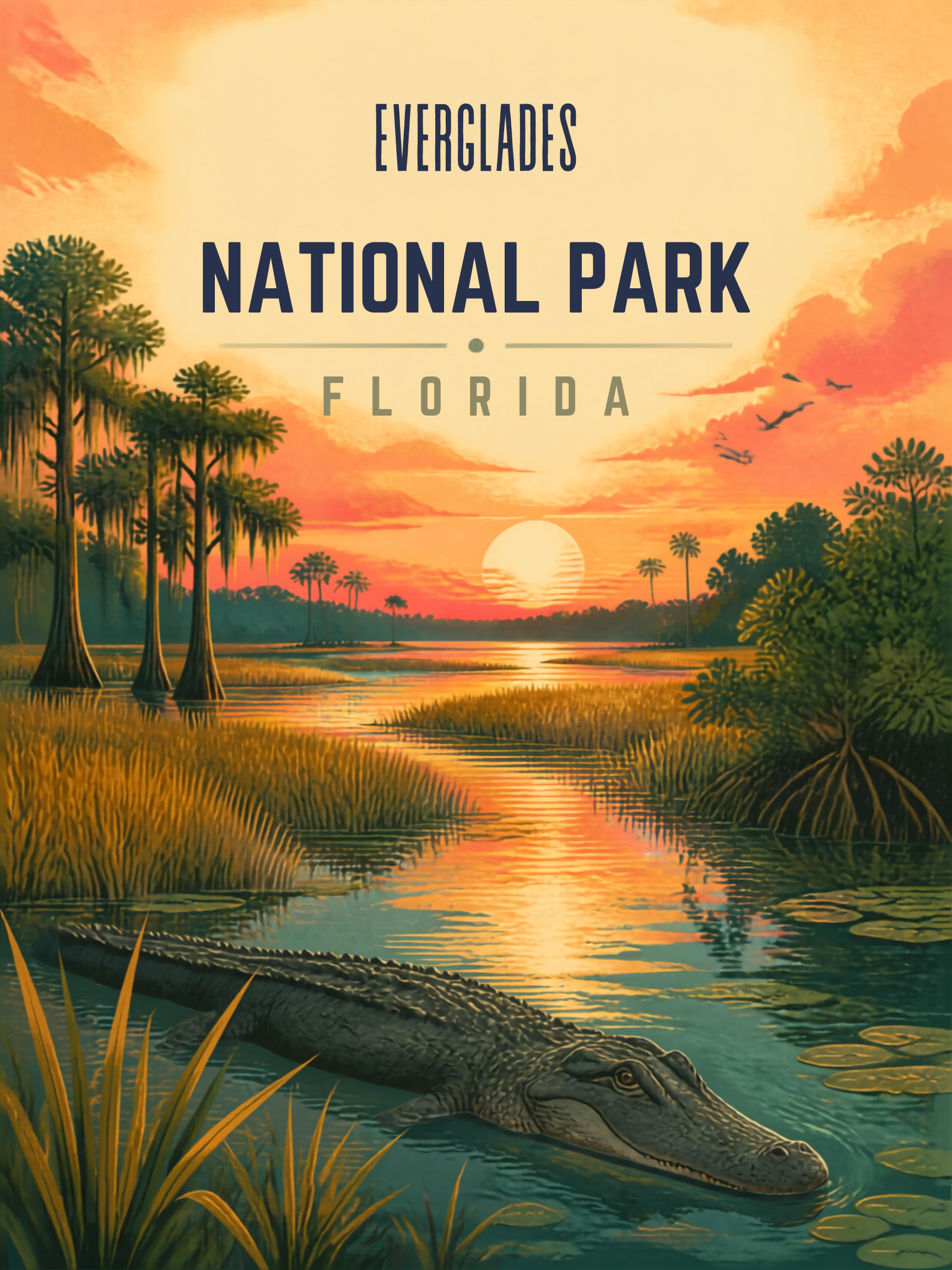
Welcome to Everglades National Park, a vast subtropical wilderness in southern Florida unlike anywhere else in North America. Known for its sawgrass marshes, mangrove forests, slow-moving waterways, and extraordinary biodiversity, the park protects one of the most fragile and important ecosystems in the world. From alligators and crocodiles to manatees and rare birds, Everglades offers one of the greatest wildlife experiences in the National Park System.

Did You Know?
- Everglades is the only place on Earth where alligators and crocodiles coexist naturally in the wild.
- It was the first national park established primarily to protect a fragile ecosystem rather than dramatic scenery or geological features.
- The park provides habitat for more than 35 threatened or endangered species, including the elusive Florida panther.
- Despite appearing flat, the “River of Grass” slowly flows south at only about a quarter mile per day.

My Personal Experience
If someone asked me for my strongest memory from Everglades National Park, my answer would immediately be: alligators. You can get remarkably close to these prehistoric-looking animals, and sometimes maybe a little too close.
I was hiking one of the park trails when I spotted a nest with two baby alligators near the boardwalk. I kept what I thought was a safe distance and became completely focused on taking pictures. Then suddenly a thought crossed my mind: “If there are babies, there must be a mother nearby.” That realization made me slowly scan the area around me and there she was. Mama Gator was enormous. I backed away immediately and very carefully. It was a good reminder that while the park is incredibly accessible, this is still true wilderness filled with powerful wildlife. You absolutely need to stay alert and aware of your surroundings at all times.
I would strongly recommend taking at least one boat tour while visiting the Everglades. Many animals are easier to observe from the water, and boat tours provide safe opportunities to get close to wildlife while exploring deeper sections of the ecosystem. Nice perk: you can watch alligators close by and still be safe on the boat. Flocks of beautiful birds and other wildlife are best spotted on such boat tours away from major roads. Everglades contains the largest designated wilderness area east of the Mississippi River and maybe with extraordinary luck you can spot one of the elusive Florida panthers that inhabit the park.

Basic Facts
Address:
Everglades National Park
40001 State Road 9336
Homestead, FL 33034
Operation Hours and Seasons:
The park is open year-round, 24 hours a day.
Visitors:
Over 1 million per year (2022)
Entrance Fees:
- Private Vehicle: $30.00 (admits one private, non-commercial vehicle and all its occupants for seven days)
- Per Person: $15.00 (when entering on foot or bicycle, valid for seven days)
Website:
nps.gov/ever
Map:
nps.gov/ever/planyourvisit/maps.htm
Additional Information:
For additional local information, visit everglades.com.

Best Time to Visit
The Everglades experience two very distinct seasons.
Dry Season (December–April)
This is the best time to visit with lower humidity, fewer mosquitoes, more comfortable temperatures, and excellent wildlife viewing as animals concentrate near water sources. Migratory birds are especially active during winter months.
Wet Season (May–November)
Expect intense humidity, daily thunderstorms, heavy mosquito activity, and flooded trails and tropical weather patterns. However, landscapes become lush and dramatically green during summerOctober through early November depending on elevation.

Recommended Time
1 Day: Focus on one major area only. The park is enormous and entrances are not internally connected. A classic first-day itinerary includes the Main Park Road from Homestead to Flamingo, the Anhinga Trail, Pa-hay-okee Overlook, and a ranger-led or commercial boat tour.
2-3 Days: Add other areas of the park, e.g. Shark Valley. Start by biking or taking the tram for the 15-mile loop to the Observation Tower. Do an airboat ride outside the park and experience culture in Miccosukee Indian Village
Serious paddlers should add additional days to explore remote sections of the backcountry and Florida Bay.

Getting There
The closest major city is Miami, Florida. Main park access areas include: Homestead Entrance (main entrance), Shark Valley and Gulf Coast / Everglades City area.
From Miami, take US-1 South to Florida City, then follow signs to the Homestead entrance. Shark Valley is accessed via US-41 (Tamiami Trail).

Weather
Everglades National Park experiences a tropical and subtropical climate year-round.
- Spring (March to May): 70s to 90s°F (21-32°C). Warm temperatures, increasing humidity, and excellent wildlife activity.
- Summer (June to August): 80s to 90s°F (27-32°C). Hot, humid, and stormy with frequent afternoon thunderstorms.
- Fall (September to November): 70s to 90s°F (21-32°C). Still humid with gradually improving weather toward late fall.
- Winter (December to February): 60s to 80s°F (15-27°C). Dry, pleasant conditions and peak visitor season.
Everglades National Park experiences significant humidity. Tropical storms and hurricanes are possible from summer through fall.

Hiking
Hiking is not the primary way to experience the Everglades, but the park still offers roughly 50 miles of trails and boardwalks through remarkably diverse ecosystems:
Easy:
- Anhinga Trail – 0.8 mile loop: One of the best wildlife-viewing trails in the entire National Park System with frequent sightings of alligators, turtles, fish, anhingas, herons, and other birds at remarkably close range.
- Gumbo Limbo Trail – 0.4 mile loop: Short forest trail through dense tropical hardwood hammock vegetation that feels completely different from the surrounding marshlands.
- Pa-hay-okee Overlook – short boardwalk: Elevated boardwalk with sweeping views across the sawgrass prairie and an excellent introduction to the scale of the “River of Grass.”
- Mahogany Hammock Trail – 0.5 miles boardwalk: Walk through dense tropical forest including the largest living mahogany tree in the United States and several other rare tropical species.
Moderate:
- Snake Bright Trial – 3.7 miles in and out: A quieter trail leading through coastal environments toward Florida Bay, often rewarding hikers with birdlife and expansive water views.
- Bayshore Loop Trail – 2 miles loop: Mangrove scenery and excellent birdwatching opportunities near Flamingo, particularly during the cooler months.
Strenuous:
- Long Pine Key Trail – 14 miles in and out: Long backcountry route through pine rocklands and remote habitats rarely seen by most visitors to the park.
- Shark Valley Tram Road – 15 miles loop: A paved route popular with cyclists that offers outstanding wildlife viewing opportunities, especially for alligators, wading birds, and turtles.
Boating and Canoeing
Water is the true heart of the Everglades. Visitor can enjoy Airboat tours outside park boundaries, ranger-led boat tours, kayaking and canoeing through mangrove tunnels, and backcountry paddling. The legendary Everglades Wilderness Waterway stretches 99 miles between Everglades City and Flamingo. This is one of America’s classic wilderness paddling routes.
Fishing
Freshwater and saltwater fishing opportunities exist throughout the park. Possible catches include snook, tarpon, redfish, sea trout, and bass.
Fishing regulations and permits apply.

Scenic Drives
- Main Park Road: This 38-mile road from Homestead to Flamingo serves as the backbone of the park and connects many of its most important overlooks, trails, visitor centers, and wildlife viewing areas. Numerous overlooks, trails, and visitor areas line the route. Road ends at Florida Bay.
- Shark Valley Road: The 15-mile paved loop is ideal for biking, tram tours, and wildlife viewing.

Best Viewpoints
Because the Everglades are remarkably flat, most viewpoints rely on elevated observation structures:
- Shark Valley Observation Tower: The highest accessible viewpoint (45 foot) in the park, offering panoramic views across miles of sawgrass marshes and one of the best opportunities to appreciate the immense scale of the Everglades.
- Pa-hay-okee Overlook: Off the Main Park Road, about 13 miles from Ernest F. Coe Visitor Center. A raised boardwalk leads to an observation tower with views of the dwarf cypress and sawgrass prairies.
- Flamingo Area: Excellent location for sunsets, Florida Bay views, birdlife, and occasional manatee sightings.

Wildlife Viewing
Everglades National Park offers some of the finest wildlife viewing in North America. Alligators are common throughout the freshwater portions of the park, while American crocodiles are most often found near coastal and brackish environments. Visitors may also encounter manatees, dolphins, river otters, turtles, and an extraordinary variety of birdlife, including roseate spoonbills, wood storks, anhingas, herons, and egrets. The elusive Florida panther remains one of North America’s rarest mammals, although sightings are exceptionally uncommon. Wildlife viewing is generally best during the dry season when animals concentrate around remaining water sources.

Photography
Everglades National Park is outstanding for wildlife and wetland photography.
- Wildlife Photography: Boardwalk trails and boat tours provide incredible opportunities for photographing reptiles and birds.
- Sunrise & Sunset: Low-angle light creates beautiful reflections across marshes and waterways.
- Storm Photography: Summer thunderstorms produce dramatic skies and lighting conditions.
- Bird Photography: Winter months are especially rewarding for bird photographers
- Wetland Landscapes: Endless sawgrass prairies, cypress domes, mangrove shorelines, and reflective waterways create uniquely Floridian landscape opportunities.

Horseback Riding
Horseback Riding is not offered in Everglades National Park due to the sensitive, swampy ecosystem. There are no horse rental concessions within the park. Guided horseback experiences are available at private ranches outside park boundaries in South Florida.

General Aviation
South Florida is one of the busiest general aviation regions in the United States. A rental car is essential because park access points are widely separated.
Miami Homestead General Aviation Airport (X51) in Homestead, FL:
- Rental car options in the city of Homestead
- 9.5 miles to Main Park Road
- Longest runway 4,001 ft
- 100LL available
Miami Exec Airport (KTMB) in Miami, FL:
- Rental car options on site
- 30 miles to Main Park Road
- Longest runway 6,000 ft
- 100LL available
Expect very high flight training traffic throughout South Florida and frequent afternoon thunderstorms during warmer months. Coastal weather and reduced visibility can develop rapidly. Strong heat and humidity increase density altitude concerns during summer.

Nearby Attractions
- Big Cypress National Preserve: The preserve is just north of Shark Valley. Excellent scenic drives, swamp ecosystems, and alligator viewing.
- Biscayne National Park: The park is located a few miles east of the Ernest F. Coe Visitor Center. Biscayne is perfect for marine wildlife viewing snorkeling, and exploring the offshore keys.
- Dry Tortugas National Park: Remote island fort accessible by boat or seaplane from Key West
- Key West: Historic island city and gateway to the Florida Keys
- Miccosukee Indian Village: Learn about the culture and history of one of South Florida’s Indigenous communities.

Important Tips
- Mosquitoes: During wet season, mosquito activity can become extreme. Bring strong insect repellent and lightweight protective clothing.
- Hydration & Heat: Heat and humidity can become dangerous year-round.
- Wildlife Distance: Never approach or feed alligators or crocodiles.
- Weather Awareness: Thunderstorms develop rapidly, especially during summer afternoons.
- Plan Your Entrances Carefully: The park’s entrances are not internally connected.
- Boat Tours: Some of the best wildlife viewing happens from the water rather than hiking trails.
- Wildlife Etiquette: Alligators often appear calm and accustomed to people, but they remain powerful wild animals. Never feed wildlife and always maintain a safe distance.
Everglades National Park protects one of the most extraordinary ecosystems on Earth. This is not a park of towering mountains or dramatic cliffs. Instead, its beauty comes from water, wildlife, silence, and life hidden within the marshes and mangroves. Whether you photograph an alligator beside a boardwalk, paddle through mangrove tunnels, watch birds rise from the sawgrass at sunset, or simply experience the humid stillness of the River of Grass, the Everglades deliver one of the most unique wilderness experiences in North America.


