Rocky Mountain Region
GRAND TETON NATIONAL PARK
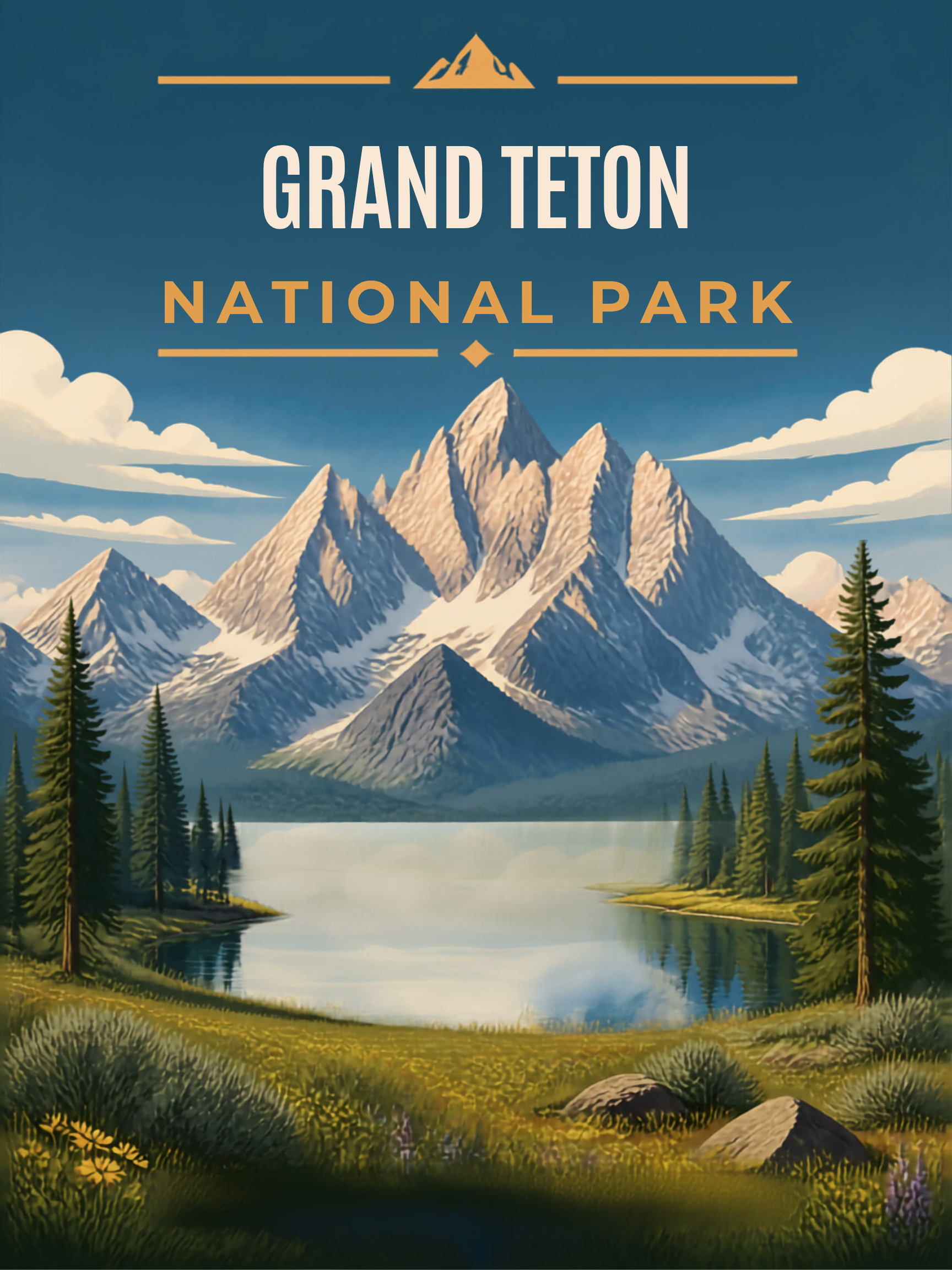
Welcome to Grand Teton National Park, a spectacular mountain landscape in northwestern Wyoming. Famous for its sharply rising peaks, crystal-clear lakes, and abundant wildlife, the park offers some of the most iconic alpine scenery in the American West. Unlike many mountain ranges, the Tetons rise abruptly from the valley floor, creating dramatic contrasts between rugged granite summits and broad sagebrush plains.
Often visited in combination with nearby Yellowstone National Park, Grand Teton stands on its own as a destination for hiking, photography, wildlife viewing, and quiet moments in one of the most striking settings in the National Park System.
Did You Know?
- Grand Teton National Park protects the youngest major mountain range in the Rocky Mountains.
- Unlike many mountain ranges, the Tetons rise directly from the valley floor with no foothills, creating one of the most dramatic mountain skylines in North America.
- The Grand Teton stands 13,775 feet above sea level and dominates the skyline throughout the park.
- Jackson Hole is one of the largest mountain valleys in the Rocky Mountains, stretching roughly 55 miles long.
- The park and neighboring Yellowstone form the core of the Greater Yellowstone Ecosystem, one of the largest intact temperate ecosystems on Earth.
My Personal Experience
Grand Teton National Park sits directly south of Yellowstone, and you should absolutely combine the two when visiting. Compared to its “big brother” to the north, Grand Teton is a relatively compact park, but it still offers an impressive number of hiking opportunities.
Looking back at my notes from July 2001, I wrote that the park was beautiful but “a bit boring.” Revisiting my photos years later, I honestly don’t know how I came to that conclusion. The images around Jackson Lake and Jenny Lake are stunning, with sweeping views across the valley and the Teton Range rising sharply in the background.
The range itself is the park’s defining feature. Its name is commonly traced to French-speaking trappers, who referred to the three most prominent peaks as les trois tétons – “the three breasts.” Crude humor aside, the name stuck, and the visual impact of the peaks certainly explains why. And honestly, who does not like an impressive fifty percent bonus.
If you’re visiting for the first time, I’d recommend hiking at least part of the Jenny Lake Trail. It’s one of the park’s easiest and most accessible walks, and it delivers classic Grand Teton scenery with relatively little effort.
Basic Facts
Address:
Grand Teton National Park
103 Headquarters Loop
Moose, WY 83012
Operation Hours and Seasons:
The park is open 24 hours a day, year-round. Visitor centers have seasonal hours.
Visitors:
Approximately 3.5 million per year (2022)
Entrance Fees:
- Private Vehicle – $35.00 admits one private, non-commercial vehicle and all its occupants for 7 days
- Per Person – $20.00
Website:
nps.gov/grte
Map:
nps.gov/grte/planyourvisit/maps.htm
Additional Information:
For additional local information, visit jacksonholechamber.com.
Important Note:
Road and trail access can be affected by snow in early spring and late fall. Always check current conditions before heading into the park.
Best Time to Visit
Many visitors consider fall the best time to visit. Crowds decline, temperatures become comfortable, and golden aspens add beautiful color to the landscape. Summer is the most popular season. All roads, visitor centers, and most trails are open. Wildflowers bloom throughout the alpine meadows and wildlife is abundant.
Spring is excellent for wildlife viewing. Bears, moose, elk, and other animals are particularly active as snow retreats from the valley floor. Winter is a quieter season that transforms the park into a winter wonderland. Cross-country skiing, snowshoeing, and wildlife viewing become the primary activities.
Recommended Time
1 Day: Drive Teton Park Road, visit Jenny Lake, stop at Schwabacher Landing and Oxbow Bend, and complete a short hike such as Taggart Lake.
2-3 Days: Ideal for most visitors. Explore Jenny Lake, Jackson Lake, Moose-Wilson Road, and several hiking trails while spending time watching wildlife.
Getting there
The closest major town is Jackson, Wyoming. From Jackson, drive north on US-191 for about 12 miles to reach the park’s southern entrance.
- Dubois, WY lies about 65 miles east and provides an alternative approach through Togwotee Pass.
- The southern boundary of Yellowstone National Park is only about 10 miles north of Grand Teton’s northern boundary along US-191, making a combined visit easy and logical.
Weather
Weather in Grand Teton varies significantly by season and elevation:
- Spring (Mar–May): 40s to 60s °F (4–20 °C). Cool, with lingering snow at higher elevations; excellent for wildlife viewing.
- Summer (Jun–Aug): 70s to low 80s °F (21–32 °C). Ideal hiking weather, but also peak visitation.
- Fall (Sep–Nov): 40s to 60s °F (4–20 °C). Crisp air, golden aspens, and fewer crowds.
- Winter (Dec–Feb): 20s to 30s °F (-6 to -1 °C). Snow transforms the park into a quiet winter landscape suitable for skiing and snowshoeing.
Hiking
Grand Teton offers trails for every level, from lakeside strolls to demanding alpine routes:
Easy:
- Taggart Lake Loop – 3 mile round trip: One of the best introductory hikes in the park. The trail passes through forest and meadows before reaching Taggart Lake, where spectacular reflections of the Teton Range often appear on calm mornings.
- Leigh Lake Trail – 2.4 miles round trip: A pleasant lakeside walk offering beautiful views of Leigh Lake and the surrounding mountains. This trail is suitable for most visitors and provides classic Grand Teton scenery.
Moderate:
- Hidden Falls and Inspiration Point – 5 miles round trip: One of the park’s most popular hikes. Visitors can shorten the distance by taking the Jenny Lake boat shuttle before hiking to Hidden Falls and Inspiration Point, which offers sweeping views across Jackson Hole.
- Phelps Lake Trail – 7 miles loop: This scenic trail circles one of the park’s most beautiful lakes and provides a variety of perspectives of the Teton Range and surrounding forests.
Strenuous:
- Cascade Canyon Trail – 9 miles round trip: One of the finest day hikes in the park. The trail follows a glacially carved canyon deep into the Teton Range and offers excellent opportunities to see wildlife, waterfalls, and alpine scenery.
- Paintbrush Canyon and Cascade Canyon Loop – 19 mile loop: Often considered the premier day hike in Grand Teton National Park. The route traverses two spectacular canyons and crosses Paintbrush Divide, rewarding hikers with some of the best mountain scenery in the Rocky Mountains.
Scenic Drives
- Teton Park Road: This 42-mile route offers numerous viewpoints, trailheads, and stunning views of the Teton Range.
- Moose-Wilson Road: Narrow and slower, but excellent for wildlife viewing and forested scenery
Best Viewpoints
- Schwabacher Landing: Perhaps the most famous photography location in the park. Calm mornings often produce perfect reflections of the Cathedral Group.
- Oxbow Bend: A classic viewpoint overlooking the Snake River with Mount Moran dominating the background.
- Snake River Overlook: Made famous by photographer Ansel Adams and still one of the park’s most iconic viewpoints.
- Jenny Lake Overlook: Provides excellent views of Jenny Lake and the towering peaks rising directly behind it.
- Signal Mountain Summit: One of the few locations accessible by road that provides panoramic views of Jackson Hole, Jackson Lake, and the Teton Range.
Wildlife Viewing
Grand Teton National Park is one of the premier wildlife-viewing destinations in North America. Moose are frequently seen near wetlands, willow flats, and lakeshores, particularly during the early morning hours. Elk, bison, pronghorn, mule deer, and bighorn sheep are commonly observed throughout the park. Both black bears and grizzly bears inhabit the area, especially in spring and early summer. Bald eagles, golden eagles, trumpeter swans, sandhill cranes, and numerous other bird species add to the park’s remarkable wildlife diversity. Dawn and dusk generally provide the best opportunities for viewing animals.
Photography
Grand Teton is defined visually by clean lines, reflections, and dramatic vertical relief:
- Teton Reflections: Grand Teton is arguably the finest reflection-photography park in the National Park System. Schwabacher Landing, Oxbow Bend, Snake River Overlook, Jenny Lake, Jackson Lake, Leigh Lake, and String Lake all provide opportunities to capture the mountains mirrored in calm water.
- Iconic Structures: The historic barns of Mormon Row have become one of the most recognizable photographic subjects in the American West. The combination of weathered historic structures and the dramatic Teton skyline creates iconic images.
- Mountain Landscapes: The abrupt rise of the Teton Range from the valley floor creates dramatic compositions throughout the park. Unlike many mountain ranges, there are few foothills to obscure the peaks.
While night photography is possible, it’s the interplay of mountains, water, and soft morning light that truly defines Grand Teton photography.
Horseback Riding
Horseback riding has been part of Grand Teton’s history since long before the park was established and remains one of the best ways to explore portions of the backcountry.
The park authorizes three concessioners that offer guided horseback rides ranging from short scenic rides to full-day backcountry experiences. Riders bringing their own horses or pack stock may access many designated trails throughout the park. Stock groups are generally limited to twelve animals, and restrictions apply in certain sensitive areas. Current regulations, trail conditions, stock-use requirements, and camping rules are available at nps.gov/grte/planyourvisit/horseback-riding.htm.
Visitors planning overnight stock trips should consult both park and adjacent national forest regulations before departure.
General Aviation
Jackson Hole Airport (KJAC) is uniquely located inside the park, making it one of the most scenic arrivals in U.S. aviation.
Jackson Hole Airport (KJAC) in Grand Teton National Park:
- Located inside Grand Teton National Park
- Longest runway: 6,300 feet
- 100LL available
- Rental cars available on-site
- Seasonal bear-spray rentals available
- START Shuttle and bus service to Jackson and Teton Village
A popular less congested alternative is
Driggs-Reed Memorial Airport (KDIJ) in Driggs, ID:
- Approximately 35 miles from Moose
- Longest runway: 7,300 feet
- 100LL available
- Rental cars available with advance arrangements
Flying into Grand Teton National Park is one of the great aviation experiences in North America. However, pilots should be comfortable operating in mountainous terrain and at high-elevation airports. Density altitude becomes a significant factor during summer months, especially for normally aspirated aircraft.
Mountain weather can change rapidly. Strong winds, turbulence, mountain wave activity, and afternoon thunderstorms are common during the warmer months. Approaches into Jackson Hole can be spectacular, but pilots should carefully review weather conditions, terrain considerations, and aircraft performance before departure.
The reward is extraordinary. Aerial views of the Tetons, Jackson Hole, Jackson Lake, and neighboring Yellowstone provide some of the most spectacular scenery available anywhere in the United States.s, but summer temperatures can still affect aircraft performance. The aerial view of the badlands is spectacular, revealing a maze of ridges, canyons, and colorful formations that is difficult to appreciate fully from the ground.
Nearby Attractions
- Yellowstone National Park: Located immediately north of Grand Teton and one of the most logical park combinations in the National Park System.
- Jackson: The primary gateway community offering lodging, restaurants, museums, shopping, and outdoor recreation.
- National Elk Refuge: Home to one of the largest elk herds in North America and particularly impressive during winter.
- Jackson Hole Mountain Resort: One of the premier ski destinations in North America and a popular year-round recreation area.
- Bridger-Teton National Forest: Provides additional hiking, camping, fishing, horseback riding, and wilderness opportunities.
Important Tips
- Carry Bear Spray: Grand Teton is prime bear habitat. Anyone hiking should carry bear spray and understand how to use it properly.
- Start Early: Wildlife viewing, photography, and parking opportunities are all significantly better during the early morning hours.
- Do Not Skip Jenny Lake: It is one of the most accessible and rewarding areas of the park, especially for first-time visitors.
- Expect Crowds in Summer: Popular areas such as Jenny Lake, Mormon Row, and Moose-Wilson Road can become congested during peak season.
- Dress in Layers: Weather can vary dramatically between the valley floor and higher elevations.
- Spend Time Away from the Road: Many visitors only experience Grand Teton from their vehicle. Even short hikes reveal a completely different side of the park.
- Combine with Yellowstone: The two parks complement each other perfectly and deserve to be experienced together whenever possible.
Grand Teton National Park is a masterpiece of simplicity. There are no geysers, giant cave systems, or towering sand dunes here. Instead, the park relies on one extraordinary asset: one of the most beautiful mountain ranges in North America rising directly from the valley floor.
Whether you are watching a moose feed in a willow marsh, photographing the sunrise at Schwabacher Landing, hiking into Cascade Canyon, or simply standing beside Jenny Lake admiring the view, Grand Teton delivers an experience that is both elegant and unforgettable. While Yellowstone may attract the headlines, Grand Teton often becomes the park visitors remember most fondly long after their trip has ended.


