Southeast Region
GREAT SMOKY MOUNTAINS NATIONAL PARK
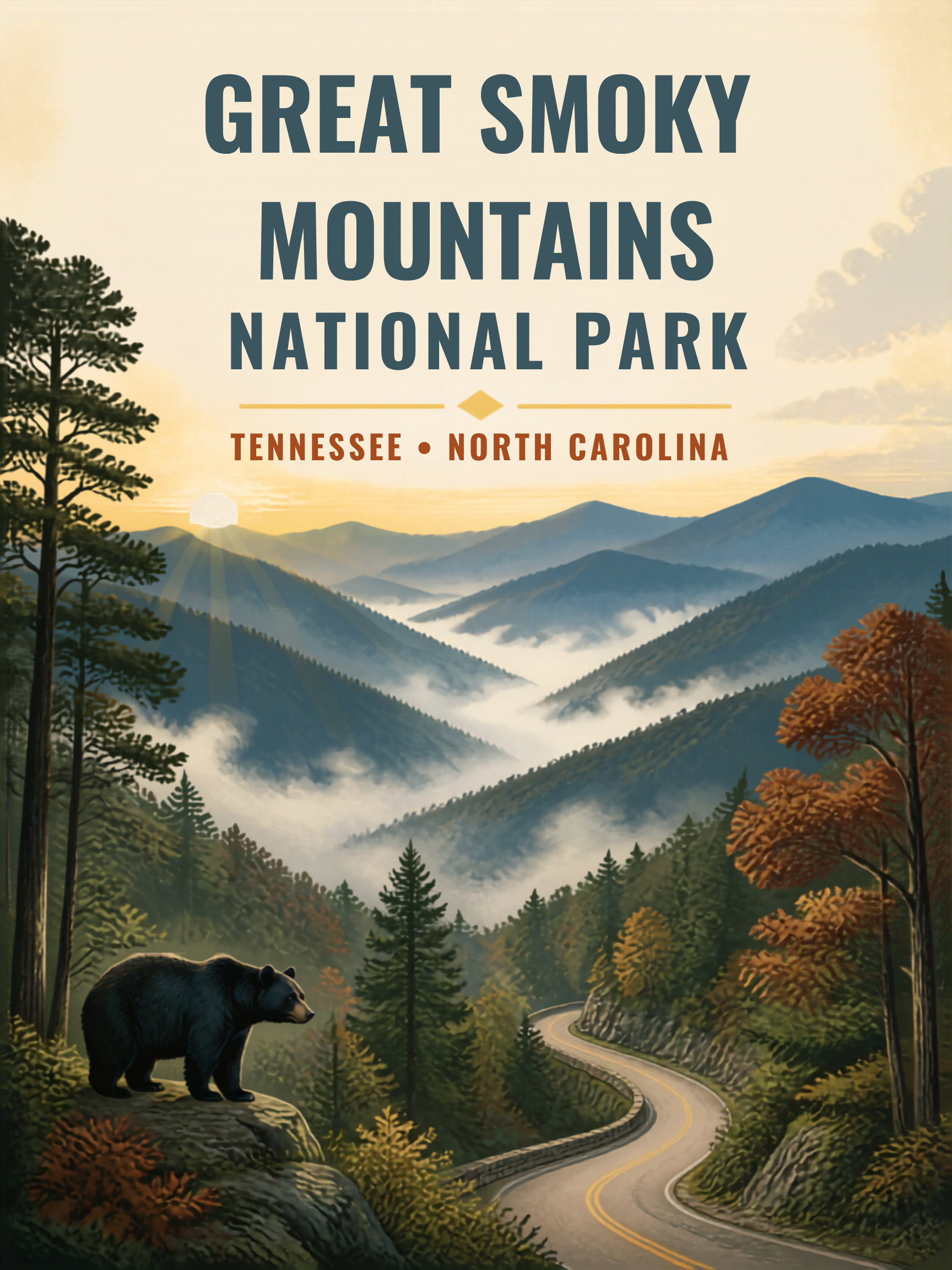
Welcome to Great Smoky Mountains National Park, a breathtaking landscape of ancient mountains, dense forests, rushing streams, and extraordinary biodiversity located along the border of Tennessee and North Carolina. Famous for its mist-covered ridges, black bears, waterfalls, Appalachian culture, and scenic drives, the park is the most visited national park in the United States.

Did You Know?
- Great Smoky Mountains is often called the “Salamander Capital of the World” with more than 30 salamander species.
- Roughly 1,500 black bears live inside the park.
- The Cherokee called the region “Shaconage,” meaning “Land of Blue Smoke”.
- The park protects one of the largest remaining temperate deciduous forests on Earth.

My Personal Experience
I visited Great Smoky Mountains National Park twice, and both visits happened during Thanksgiving week. That timing came with one major challenge: crowds. Great Smoky Mountains is the most visited park in the entire National Park System, and especially around holidays, traffic and parking can become a serious issue. Unlike some western parks, there is no large shuttle network to move visitors around, so almost everyone arrives by car. Parking became such a challenge that the park introduced parking tags for vehicles staying longer than 15 minutes. You should mentally prepare for the possibility that your visit might partially turn into a scenic driving experience because finding parking near major trailheads can be difficult. Luckily, we managed to secure a parking spot near one of the waterfall trails. The trail itself was busier than a Walmart on a Sunday afternoon.
For first-time visitors, I would absolutely recommend visiting Clingmans Dome or Kuwohi, as it was officially renamed in 2024 to restore the original Cherokee name. The observation tower offers panoramic views across the Smokies when weather cooperates. Fog is common though; the mountains are called “Smoky” for a reason. We did not see much wildlife beyond deer, although the park has one of the largest black bear populations in the eastern United States. Thanksgiving may simply have been a little late in the season for frequent bear activity.
One thing I particularly liked was standing on a small section of the Appalachian Trail. Even if you never plan to thru-hike all 2,000+ miles, it is still special to experience a tiny piece of one of America’s most legendary trails. For lodging, I would personally recommend nearby Asheville or Knoxville. Of course, Pigeon Forge is also an option and surreal in its own entertaining way.

Basic Facts
Address:
Great Smoky Mountains National Park
107 Park Headquarters Road
Gatlinburg, TN 37738
Operation Hours and Seasons:
The park is open year-round, 24 hours a day.
Visitors:
Over 12 million per year (2022)
Entrance Fees:
The park does not charge an entrance fee but visitors must buy parking tags for their vehicle if they intend to park for more than 15 minutes. Costs are 5$ for a daily tag, 15$ weekly, or 40$ for an annual parking tag.
Website:
nps.gov/grsm
Map:
nps.gov/grsm/planyourvisit/maps.htm
Additional Information:
For additional local information, visit mysmokymountainpark.com.

Best Time to Visit
The best time to visit depends heavily on your priorities.
- Late April–May: Wildflowers, waterfalls, and excellent hiking weather
- September–Early November: Spectacular fall foliage and cooler temperatures
- Summer: Full access to all roads and facilities but very crowded
- Winter: Much quieter with occasional snow and dramatically reduced traffic
Peak fall foliage usually occurs from mid-October through early November depending on elevation.

Recommended Time
1 Day: If you have one day only, skip Cades Cove as most of the crowds will congregate there. Drive Newfound Gap Road, visit Kuwohi (formerly Clingmans Dome), stop at scenic overlooks, and choose one waterfall or mountain hike. If possible, start very early to avoid traffic and parking problems.
2-3 Days: Ideal for combining scenic drives, waterfall hikes, wildlife viewing, and Appalachian history. Add Cades Cove, Roaring Fork Motor Nature Trail, or sections of the Appalachian Trail. Explore nearby attractions like Gatlinburg, Sevierville and Pigeon Forge.

Getting There
The closest major cities are Knoxville, Tennessee, and Asheville, North Carolina. Popular access points include: Gatlinburg, TN, Townsend, TN, or Cherokee, NC.
From Knoxville, take US-441 South to the park entrance. From Asheville, take I-40 West to US-441 South to the park entrance.

Weather
Weather in the Smokies changes dramatically with elevation.
- Spring (March to May): 40s to 70s°F (4-21°C). Wildflowers bloom throughout the park and waterfalls flow strongly from snowmelt and rain.
- Summer (June to August): 70s to 80s°F (21-27°C). Warm, humid conditions with frequent afternoon thunderstorms.
- Fall (September to November): 40s to 70s°F (4-21°C). Cooler temperatures and spectacular foliage colors make this the park’s most popular season.
- Winter (December to February): 30s to 50s°F (-1 to 10°C). Lower elevations remain accessible while higher elevations may receive snow and ice.
Elevation plays a major role in the Smokies. Conditions at Kuwohi or Newfound Gap can be dramatically different from nearby towns such as Gatlinburg or Cherokee, and fog can appear with little warning.

Hiking
Great Smoky Mountains offers more than 800 miles of trails ranging from short waterfall walks to strenuous mountain climbs:
Easy:
- Laurel Falls Trail – 2.6 miles round trip: One of the park’s most popular hikes leading to a picturesque waterfall. The paved trail makes it accessible for many visitors, but expect crowds during peak seasons.
- Clingmans Dome Observation Tower – 0.5 miles round trip: A short but steep paved climb to the highest point in the park, rewarded with panoramic views across the Smokies and beyond.
- Cade Cove Nature Trail – 2.0 miles: A peaceful walk highlighting Appalachian history and local ecology.
Moderate:
- Abrams Falls Trail – 5 miles round trip: A relatively moderate hike leading to one of the park’s most photogenic waterfalls.
- Mouse Creek Falls Trail- 4 miles round trip: Follows an old railroad grade beside streams and forest scenery to a beautiful waterfall.
- Hen Wallows Falls Trail – 4.4 miles round trip: A rewarding forest hike to a tall waterfall tucked away in a quiet section of the park.
Strenuous:
- Chimney Tops Trail – 4 miles round trip: Short but steep hike with dramatic elevation gain and spectacular mountain views.
- Alum Cave Trail – 5 miles round trip: Features rock bluffs, tunnels, and unique geological formations.
- Mount LeConte via Alum Cave Trail – 11 miles round trip: One of the park’s classic hikes to the third-highest peak in the Smokies. The hike includes stairs, bridges and some steep and rocky sections. On clear days, the summit area offers some of the finest mountain views in the eastern United States.

Scenic Drives
- Cades Cove Loop: An 11 mile loop famous for open valley views, historic cabins, and wildlife sightings. High likelihood of spotting black bears. Expect heavy traffic during peak periods.
- Roaring Fork Motor Nature Trail: A 6 mile narrow one way road near Gatlinburg, TN that winds through old-growth forest alongside historic cabins, waterfalls, and mountain streams.
- Newfound Gap Road: 33 miles main artery of the park connecting Gatlinburg, TN to the Cherokee reservation. Its high-elevation offers panoramic views and trail access points.

Best Viewpoints
- Clingmans Dome: The highest point in the park, offering spectacular 360-degree views across Tennessee and North Carolina on clear days.
- Morton Overlook: One of the most popular sunset locations in the Smokies, with layered mountain ridges fading into the distance.
- Newfound Gap: Located on the Tennessee–North Carolina border, this historic mountain pass offers scenic overlooks and direct access to the Appalachian Trail.
- Cades Cove: Wide-open valley scenery surrounded by mountain ridges, particularly beautiful during early morning and late afternoon.

Wildlife Viewing
Great Smoky Mountains National Park is one of the best places in the eastern United States to observe wildlife. Black bears are the park’s most famous residents, and although sightings are never guaranteed, areas such as Cades Cove often provide some of the best opportunities. White-tailed deer, wild turkeys, coyotes, and foxes can be seen throughout the park, while elk have successfully returned to portions of the North Carolina side, particularly around Cataloochee Valley. Early morning and evening are generally the most productive times for wildlife viewing. As always, maintain a safe distance and never approach or feed wildlife.

Photography
The Smokies are a paradise for landscape and nature photographers.
- Fog & Layered Mountains: Morning fog creates the iconic blue “smoky” appearance across the ridges.
- Waterfalls: The park contains countless waterfalls ranging from roadside cascades to remote backcountry falls.
- Fall Colors: Fall foliage attracts photographers from around the world.
- Wildlife Photography: Cades Cove and Cataloochee Valley are prime locations for photographing deer, bears, and elk.
- Night Photography: Higher elevations occasionally provide excellent astrophotography conditions, though humidity and haze can limit visibility.
- Scenic Roads: Newfound Gap Road, Cades Cove Loop Road, and Roaring Fork Motor Nature Trail provide countless opportunities for roadside photography and scenic overlooks.

Horseback Riding
Great Smoky Mountains National Park is one of the best horseback riding parks in the eastern United States, with more than 550 miles of trails open to stock use. Obtain a copy of the park’s trails map at nps.gov/grsm/planyourvisit/horseriding.htm and check the regulations. Five drive-in horse camps provide access to backcountry trails. Camps are open from April to October.
Three concession riding stables offer guided horseback rides from mid-March through late-November. Offered rides take between 45 minutes to several hours:
- Sugarlands near Gatlinburg, TN
- Cades Cove near Townsend, TN
- Smokemont near Cherokee, NC

General Aviation
Reliable rental car access is essential because the park is spread across a large mountainous region.
Gatlinburg-Pigeon Forge Airport (KGKT) in Sevierville, TN:
- Limited rental car options nearby
- 15 miles north of the park
- 5,506 asphalt runway
- 100LL available
Asheville Regional Airport (KAVL) in Asheville, NC:
- Multiple rental car options
- 8,002 asphalt runway
- 60 miles south of the park
- 100LL available
Mountain flying experience is strongly recommended. Fog, downdrafts, turbulence, and rapidly changing weather are common. Valleys can trap low clouds and reduce visibility unexpectedly. Density altitude becomes more relevant during humid summer months. Mountain ridges frequently generate turbulence and low clouds, particularly during the morning and evening hours. Pilots should be prepared for rapidly changing weather and limited options once inside mountain valleys.

Nearby Attractions
- Blue Ridge Parkway: One of America’s most scenic drives
- Biltmore Estate: Historic mansion and gardens in Asheville
- Gatlinburg: Tourist gateway town with restaurants, attractions, and mountain culture
- Pigeon Forge: Entertainment-heavy mountain tourism destination
- Great Smoky Mountains Railroad: Scenic train excursions through western North Carolina
- Cherokee: Cultural center of the Eastern Band of Cherokee Indians and an important gateway community on the park’s eastern side.

Important Tips
- Arrive Early: Parking fills extremely quickly at popular trailheads and scenic areas.
- Traffic: Expect congestion during holidays, weekends, and fall foliage season.
- Bear Safety: You are in black bear country. Store food properly and maintain safe distances from wildlife.
- Weather Changes Quickly: Higher elevations may have entirely different weather conditions than surrounding towns.
- Cell Coverage: Coverage is unreliable throughout much of the park.
- Fall Foliage: Peak foliage attracts massive crowds. Weekdays are much calmer than weekends.
Great Smoky Mountains National Park is America’s most visited national park for good reason.
The combination of ancient mountains, mist-covered ridges, waterfalls, Appalachian history, incredible biodiversity, and endless recreational opportunities creates a park experience that feels both accessible and wild. Whether you drive scenic mountain roads, stand on the Appalachian Trail, search for black bears in Cades Cove, or simply watch layers of blue ridges disappear into the distance, the Smokies offer one of the most quintessential national park experiences in the eastern United States.


