Rocky Mountain Region
WIND CAVE NATIONAL PARK
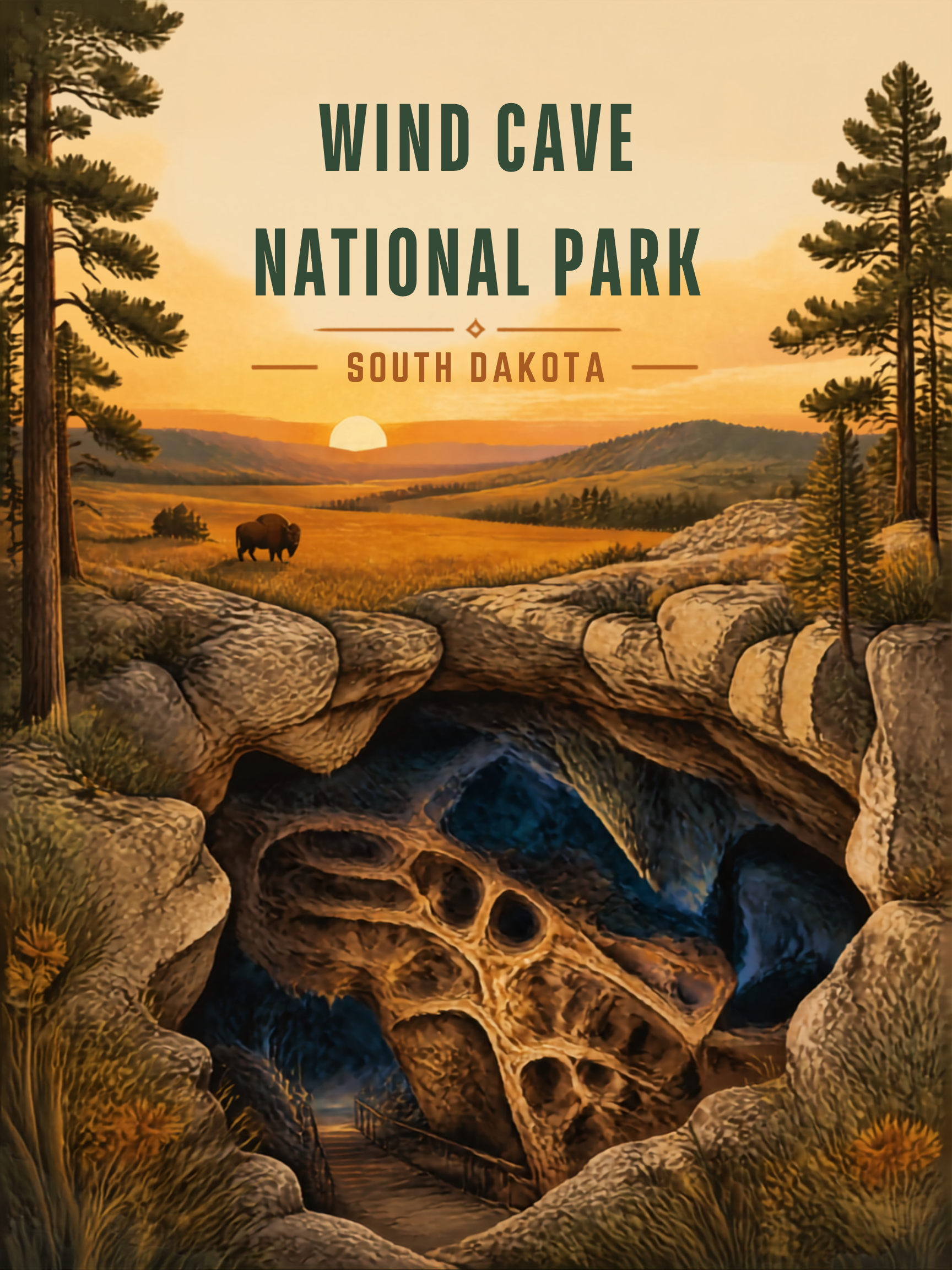
Wind Cave National Park, located in the southern Black Hills of South Dakota, is famous for its vast underground cave system and its diverse surface landscapes of mixed-grass prairie and ponderosa pine forest. Established in 1903, it was the first cave in the world to be designated a national park. Today, Wind Cave protects both a fragile underground wonder and a thriving above-ground ecosystem where bison, elk, and prairie dogs roam.
The park is also part of a rich cultural landscape: nearby Badlands National Park, Custer State Park, Mount Rushmore National Memorial, Jewel Cave National Monument, and the Crazy Horse Memorial make this corner of South Dakota one of the most rewarding road-trip destinations in the country.

Did You Know?
- Wind Cave became the world’s first cave to be designated a national park in 1903.
- The cave is famous for its boxwork formations, a rare honeycomb-like calcite structure found in few places on Earth.
- More than 160 miles of cave passages have been mapped, making Wind Cave one of the longest caves in the world.
- The cave’s name comes from the strong airflow at its natural entrance. Changes in atmospheric pressure cause air to move in and out of the cave, creating the “wind” that first attracted attention to the site.

My Personal Experience
Wind Cave National Park is one of the few places I’ve only managed to visit once, but it left a strong impression. Watching prairie dogs pop up from their burrows and spotting bison grazing on the prairie already makes the visit worthwhile. But a trip to Wind Cave wouldn’t be complete without venturing below the surface.
The cave maintains a steady 53°F (12°C) year-round so bring a sweater, even in the heat of summer. Underground, the highlight is boxwork, a rare honeycomb-like formation found in very few caves worldwide. It’s delicate, intricate, and unique something you won’t soon forget.
I was fascinated by the park’s history, too. To the Lakota people, Wind Cave is sacred, tied to their origin stories. For settlers, it became a place of discovery and curiosity. The cave was first “found” by Europeans in 1881, when two brothers heard a loud, whistling sound coming from a small hole in the ground, the only natural entrance to the cave.
For the full Black Hills experience, I strongly recommend pairing your Wind Cave visit with nearby Custer State Park, which many consider one of the most beautiful state parks in the U.S., and the rugged, otherworldly landscapes of Badlands National Park.
Basic Facts
Address:
Wind Cave National Park
26611 US Highway 385
Hot Springs, SD 57747
Operation Hours and Seasons:
The park is open from 8 AM to 4:30 PM, year-round. Cave tours operate on a seasonal schedule.
Visitors:
Over 600,000 per year (2022)
Entrance Fees:
The park does not charge an entrance fee but you need to book a guided tour to visit the caves.
Website:
nps.gov/wica
Map:
nps.gov/wica/planyourvisit/maps.htm
Additional Information:
For additional local information, visit travelsouthdakota.com.

Best Time to Visit
Wind Cave National Park is a year-round destination, although each season offers a different experience.
Spring brings mild temperatures, green prairies, and active wildlife. It is one of the best seasons for observing bison, prairie dogs, and wildflowers.
Summer provides full access to cave tours and hiking trails. While surface temperatures can become warm, the cave remains a comfortable 53°F throughout the year.
Fall offers pleasant hiking weather, fewer visitors, and beautiful colors in the park’s grasslands and forests.
Winter is the quietest season. Snow occasionally covers the prairie, creating striking scenery and excellent wildlife viewing opportunities. Cave tours continue on a limited schedule.

Recommended Time
1 Day: This is sufficient for most visitors. Take a cave tour, visit the visitor center, drive through the park, and spend time observing wildlife in the prairie ecosystem.
2-3 Days: Ideal for visitors who enjoy hiking and wildlife photography. Explore multiple trails, participate in several cave tours, and combine your visit with nearby attractions such as Custer State Park and Jewel Cave.
Getting There
The nearest city with a major airport is Rapid City, South Dakota (~60 miles away). From Rapid City, follow US-79 South and connect to US-385 South to reach the park entrance.
Weather
Wind Cave National Park experiences varied weather throughout the year
- Spring (March to May): Temperatures range from 40s to 60s°F (4-20°C). Mild and ideal for hiking.
- Summer (June to August): Highs range from 70s to 90s°F (21-32°C). Warm and ideal for exploring both the cave and surface trails.
- Fall (September to November): Temperatures range from 40s to 70s°F (4-21°C). Clear and pleasant days.
- Winter (December to February): Highs in the 30s to 50s°F (-1 to 10°C). Cold with occasional snow; fewer visitors.
Be prepared for extreme temperature fluctuations between day and night throughout the year. It’s advisable to check the specific weather forecast before planning a trip and to be prepared for sudden changes in weather conditions.
Hiking
Wind Cave National Park offers a variety of trails for all levels
Easy:
- Rankin Ridge Nature Trail – 1 mile loop: Enjoy panoramic views and a fire tower.
- Elk Mountain Nature Trail – 1 mile loop : Hike through ponderosa pine forest.
Moderate:
- Lookout Point Trail – 5.3 miles loop: This trail leads through mixed-grass prairie and forest.
Strenuous:
- Highland Creek Trail – 7.8 miles loop: Diverse terrain and wildlife viewing opportunities.
Cave Tours
Wind Cave offers several guided tours to explore its unique cave formations. All tours are ranger-guided and leave from the visitor center.There are no self-guided tours. You must purchase a ticket if you like to go into the caves. Advance reservations are available for some tours; all other tickets are sold on a first-come, first-serve basis on the day of the tour at the visitor center. Tours often sell out 1-2 hours in advance, and long lines are common in spring, summer, and fall. Plan accordingly! Check the park’s website for current ticket prices; no cash, credit card or electronic payments only.
- Garden of Eden Tour: A 1-hour tour through some of the cave’s most decorated rooms. This tour is the least strenuous
- Fairgrounds Tour: A 1.5-hour tour that covers a variety of cave formations.
- Candlelight Tour: A 2-hour tour conducted by candle lanterns for a historic experience.
Scenic Drives
- Wildlife Loop Road: Although located primarily within nearby Custer State Park, this scenic drive is one of the premier wildlife-viewing roads in the Black Hills and is often combined with a visit to Wind Cave. Bison, pronghorn, burros, and prairie dogs are frequently observed.
- US Highway 385 Corridor: The highway connecting Wind Cave, Custer State Park, and Deadwood passes through some of the most scenic portions of the Black Hills and provides excellent opportunities for sightseeing.
- Southern Black Hills Scenic Drives: Several county and state roads surrounding the park offer beautiful views of rolling prairie, ponderosa pine forests, and granite formations.
Best Viewpoints
- Rankin Ridge: The highest point in the park accessible by trail. Visitors are rewarded with panoramic views of the Black Hills, surrounding prairie, and distant mountain ranges.
- Lookout Point: One of the best locations for appreciating the transition between prairie and forest ecosystems that defines much of Wind Cave National Park.
- Prairie Vistas: Some of the most memorable views in the park are not tied to a specific overlook. The open grasslands, bison herds, and distant Black Hills create beautiful scenery throughout the park.
Wildlife Viewing
Wind Cave protects one of the finest remaining mixed-grass prairie ecosystems in the United States. Visitors frequently encounter bison, prairie dogs, elk, pronghorn, and wild turkeys throughout the park. Coyotes are regularly observed in open grasslands, while hawks, eagles, and other raptors patrol the skies above. Early morning and evening generally provide the best wildlife-viewing opportunities, particularly during the spring and fall months when temperatures are cooler and animal activity is highest.

Photography
Wind Cave offers two very different photography experiences: the prairie above ground and the cave below.
- Prairie photography: The park’s rolling grasslands provide excellent opportunities for wildlife photography, particularly of bison, prairie dogs, elk, and pronghorn. Early morning and late afternoon light often creates beautiful conditions across the open prairie. Landscape photographers should visit Rankin Ridge and other elevated areas of the park to capture sweeping views of the Black Hills and surrounding grasslands.
- Cave Photography: Inside the cave, photography can be challenging because of the low-light conditions. Visitors who take a cave tour should be prepared for slower shutter speeds and should carefully follow all National Park Service photography regulations. The rare boxwork formations are among the most unique photographic subjects found in any cave system in the world.
Horseback Riding
Horseback riding is permitted on many backcountry trails and routes within Wind Cave National Park. Visitors bringing their own horses must comply with current National Park Service regulations regarding stock use, feed requirements, and designated riding areas. Current regulations are available at: nps.gov/wica/planyourvisit/horsebackriding.htm.
Wind Cave does not currently offer National Park Service guided horseback rides within the park. However, several commercial outfitters in the surrounding Black Hills region provide guided horseback riding experiences.
General Aviation
The nearby town of Hot Springs only has limited availability of rental cars. Rapid City, South Dakota offers reliable rental car availability.
Hot Springs Municipal Airport (KHSR) in Hot Springs, SD:
- The closest airport to Wind Cave National Park
- Approximately 10 miles from the park
- Longest runway: 4,400 feet
- 100LL available
- Rental cars may be available with advance arrangements
- Excellent access to Wind Cave and the southern Black Hills
Rapid City Regional Airport (KRAP) in Rapid City, SD:
- The most practical airport for many visitors
- Approximately 60 miles from the park
- Longest runway: 8,701 feet
- 100LL available
- Extensive rental car availability
- Full-service facilities
Flying in western South Dakota is generally straightforward, but pilots should remain aware of rapidly changing weather conditions, particularly during spring and summer thunderstorm season. Moderate turbulence and strong winds occasionally occur near the Black Hills. Density altitude can also become a factor during the summer months. The relatively open terrain and numerous nearby airports make this one of the more accessible national park regions for general aviation pilots.
Nearby Attractions
- Badlands National Park: Famous for its dramatic rock formations, fossil beds, and expansive prairie landscapes. The park is frequently combined with a visit to Wind Cave.
- Custer State Park: Arguably the best state park in America, featuring scenic drives, granite spires, mountain lakes, and abundant wildlife.
- Mount Rushmore National Memorial: One of the most recognizable landmarks in the United States and a highlight of any Black Hills itinerary.
- Jewel Cave National Monument: One of the longest caves in the world and an excellent complement to Wind Cave.
- Crazy Horse Memorial: A massive mountain carving that honors the Lakota leader Crazy Horse and celebrates Native American culture and history.
Important Tips
- Reserve Cave Tours Early: Tour availability varies throughout the year and popular tours may sell out during peak travel periods.
- Bring a Sweater: The cave remains approximately 53°F year-round, regardless of outside temperatures.
- Spend Time Above Ground: Many visitors focus exclusively on the cave and miss the park’s outstanding prairie ecosystem and wildlife-viewing opportunities.
- Watch for Wildlife on Roads: Bison, elk, and pronghorn frequently cross roadways, especially during early morning and evening hours.
- Carry Water: The prairie environment can become surprisingly warm during the summer months.
- Combine Nearby Attractions: Wind Cave is ideally located for exploring the broader Black Hills region, including Custer State Park, Mount Rushmore, Jewel Cave, and Badlands National Park.
Wind Cave National Park is a place of contrasts. Above ground, visitors experience one of the finest remaining mixed-grass prairie ecosystems in North America, complete with free-roaming bison, prairie dogs, elk, and expansive views across the Black Hills. Below ground lies a vast and mysterious cave system filled with rare boxwork formations found in few other places on Earth.
While Wind Cave may not receive the same attention as some of America’s larger national parks, it rewards visitors with a unique combination of geology, wildlife, history, and cultural significance. Whether your favorite memory comes from exploring the underground passages or watching a bison herd graze across the prairie, Wind Cave offers an experience that is both distinctive and unforgettable.


