Southwest Region
BIG BEND NATIONAL PARK
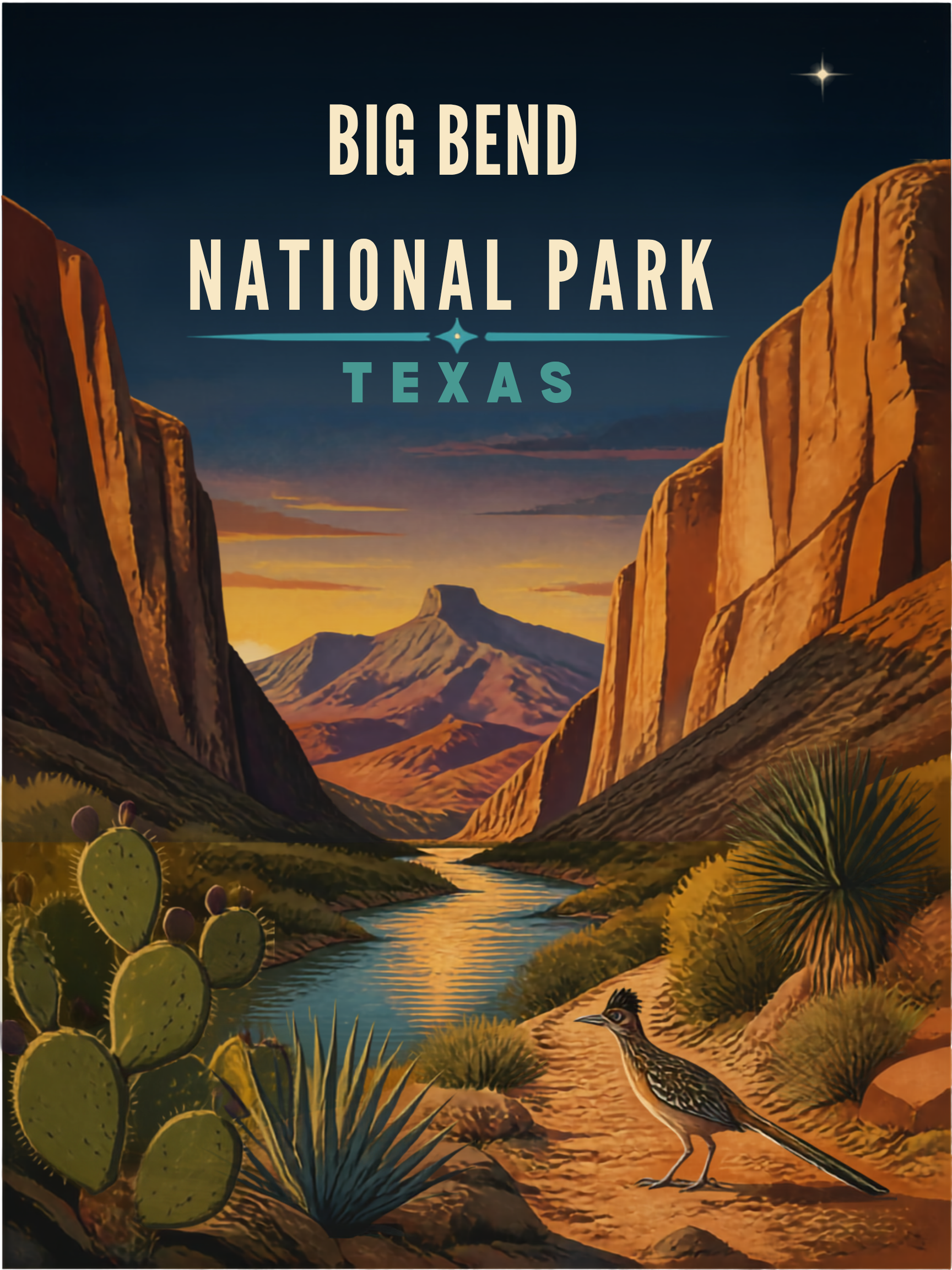
Welcome to Big Bend National Park, a vast and diverse landscape of rugged mountains, desert expanses, and the winding Rio Grande River located in southwestern Texas. The park offers stunning scenery, rich cultural history, outstanding wildlife viewing, and some of the most remote and rewarding outdoor experiences in the National Park System.

Did You Know?
- The park boasts more bird species than any other U.S. national park.
- Among all 63 national parks, Big Bend is the only one to completely contain an entire mountain range: the Chisos Mountains.
- Big Bend shares an international border with Mexico, with the Rio Grande serving as the natural border for 118 miles.

My Personal Experience
Although you can drive to Big Bend National Park, it is not an easy place to get to. The closest major city is El Paso, and it takes about five hours to reach the park.
There are two things I remember most from my visit: the Rio Grande and snakes.
I visited Santa Elena Canyon and actually made my way down to the shore of the Rio Grande, which serves as the natural border between the United States and Mexico for 118 miles within the park. Along the way, I found traces of illegal border crossings and items left behind for sale. Thankfully, I had read the park brochure and additional information beforehand. Visitors should never purchase any of these items, as they are considered contraband. All roads leading out of the park are monitored by U.S. Border Patrol checkpoints.
The river itself was impressive. Standing on the banks of the Rio Grande after growing up watching countless Western movies set somewhere along its course left a lasting impression on me.
My second memory is snakes. They are everywhere and I mean everywhere. The park is home to 31 species of snakes, including four species of rattlesnakes. During my visit, I had to swerve several times to avoid running over snakes crossing the road.
I visited in late September, which is already near the end of the off-season, yet it was still extremely hot. My next visit will certainly be in the middle of winter. Well, I need to come again anyway to take pictures. My camera’s memory card failed and I lost all pictures of the visit to Big Bend.

Basic Facts
Address:
Big Bend National Park
PO Box 129
Big Bend National Park, TX 79834
Operation Hours and Seasons:
The park is open year-round, 24 hours a day.
Visitors:
Over 450,000 per year (2022)
Entrance Fees:
- Private Vehicle: $30.00 (admits one private, non-commercial vehicle and all its occupants for seven days)
- Per Person: $15.00 (when entering on foot or bicycle, valid for seven days)
Website:
nps.gov/bibe
Map:
nps.gov/bibe/planyourvisit/maps.htm
Additional Information:
For additional local information, visit visitbigbend.com.

Best Time to Visit
Late fall through early spring is the best time to visit. Daytime temperatures are generally pleasant, making hiking, sightseeing, and camping much more enjoyable.
Summer temperatures can be extreme, particularly in the desert portions of the park where temperatures frequently exceed 100°F. Heat-related illness is a serious concern, and many hikes that are comfortable in winter can become dangerous during the summer months.

Recommended Time
Big Bend is really three parks in one: the Chisos Mountains, the Chihuahuan Desert, and the Rio Grande corridor.
1 Day: Big Bend is simply too large to do justice in a single day, especially considering the long drive required to reach it. Focus on one of the three major regions and explore it thoroughly.
2-3 Days: Three days is strongly recommended. This allows enough time to experience all three regions, drive the major park roads, and enjoy several of the park’s signature hikes and viewpoints. Add more days if you also like to explore some of the unimproved dirt roads.

Getting There
The closest major city is Midland, Texas. From Midland, take I-20 West to US-385 South to the park entrance.
Other common Texan gateways include El Paso, Marfa, or Alpine. No matter which direction you arrive from, expect a long drive through remote West Texas landscapes.

Weather
Big Bend experiences dramatic seasonal and elevation-related weather variations:
- Spring (March to May): 50s to 80s°F (10-27°C). Wildflowers often bloom throughout the desert following wetter winters.
- Summer (June to August): 90s to 100s°F (32-38°C) in lower elevations. Hiking can become dangerous during the middle of the day.
- Fall (September to November): 50s to 80s°F (10-27°C). Pleasant conditions return, making this an excellent season for hiking and scenic drives.
- Winter (December to February): 50s to 70s°F (10-21°C). The desert is often comfortable while the Chisos Mountains can experience occasional frost or snow.
Temperatures can vary significantly between the desert floor and the higher elevations of the Chisos Mountains. Always check current forecasts before your visit.

Hiking
Big Bend offers excellent hiking opportunities for all skill levels. Always consider seasonal temperatures when selecting hikes.
Easy:
- Window View Trail – 0.3 miles loop: Short paved trail offering beautiful views toward the Window and surrounding Chisos Mountains.
- Rio Grande Village Nature Trail – 0.75 miles loop: Self guided trail with river, mountain, and wetland views.
Moderate:
- Lost Mine Trail – 4.8 miles round trip: One of the park’s most popular hikes, offering spectacular views of the Chisos Basin.
- Santa Elena Canyon Trail – 1.7 miles round trip: Short but dramatic hike into one of the park’s most iconic canyons.
- Window Trail – 5.6 miles round trip: Descends from the Chisos Basin through oak and juniper forest to the famous Window pour-off overlooking the desert below.
Strenuous:
- South Rim Trail – 12 miles loop: Arguably the premier hike in the park, featuring breathtaking views across Texas and Mexico.
- Emory Peak Trail – 10.5 miles loop: Leads to the highest point in the park with outstanding panoramic views.
- Ernst Tinaja Trail – 0.5 miles one way: Short but rough route through a dramatic desert wash leading to natural rock basins and colorful geology.
- Marufo Vega Trail – 12-14 miles loop: One of the park’s most challenging desert hikes with spectacular Rio Grande views and very little shade
Boating and Rafting
The Rio Grande offers excellent opportunities for rafting, canoeing, and kayaking. Guided river trips are available through commercial outfitters operating near the park. River conditions vary throughout the year, and advance planning is recommended.
Backpacking
Big Bend contains extensive backcountry areas suitable for overnight wilderness travel.
Backcountry permits are required for overnight camping. The park offers opportunities ranging from mountain backpacking in the Chisos to remote desert campsites accessible via primitive roads.

Scenic Drives
- Chisos Basin Road: A six-mile drive showcasing the dramatic transition from desert to mountain environments.
- Ross Maxwell Scenic Drive: A 30-mile route highlighting geology, desert scenery, and access to Santa Elena Canyon.
- Panther Junction to Rio Grand Village: A scenic 21-mile drive featuring expansive views and access to the river corridor.
- Persimmon Gap to Panther Junction: The primary north entrance route through classic Chihuahuan Desert landscapes.
- Maverick Entrance Station to Panther Junction: A scenic 23-mile drive through broad desert valleys framed by mountain ranges.

Best Viewpoints
- The Window: One of the park’s most iconic views, especially at sunset
- Santa Elena Canyon Overlook: Outstanding views of towering canyon walls carved by the Rio Grande
- South Rim: Arguably the finest viewpoint in the park
- Sotol Vista: Broad panoramic views across the Chihuahuan Desert
- Mule Ears: Classic roadside view of the park’s distinctive volcanic peaks.

Wildlife Viewing
Big Bend supports exceptional biodiversity. Visitors may encounter javelinas, mule deer, coyotes, roadrunners, jackrabbits, black bears, and, in very rare cases, mountain lions. The park is also one of the premier birdwatching destinations in North America, with more than 450 recorded bird species. Reptiles are common throughout the park, including numerous lizards and 31 species of snakes. Early morning and evening provide the best wildlife viewing opportunities, particularly near water sources and along the Rio Grande corridor.

Photography
Capture the stunning desert landscapes and unique geological features:
- Golden Hour: Warm desert light enhances the colors and textures of the Chisos Mountains, desert landscapes and canyon walls.
- River Photography: Santa Elena Canyon and the Rio Grande provide outstanding opportunities for landscape photography.
- Night Photography: Big Bend is recognized as one of the premier dark-sky destinations in North America. The remote location and minimal light pollution create excellent conditions for Milky Way photography and astrophotography.
- Wildlife Photography: Birds, mammals, reptiles, and dramatic desert scenery provide endless photographic subjects throughout the park.
- Desert Landscapes: Mule Ears, Sotol Vista, and the Ross Maxwell Scenic Drive provide classic Southwest compositions.
- Mountain Photography: The Chisos Mountains create opportunities rarely found elsewhere in Texas, particularly during sunrise and after storms

Horseback Riding
You must bring your own stock as there are no horses or pack animals for hire in or near the park. All gravel roads are open to horses. Cross country travel is permitted in the whole park with certain limitations in the Chisos Mountain. Horses can be watered in the Rio Grande or in springs not used for domestic water supply. Grazing is not permitted so you must bring your own food. Bring plenty of water as well as some springs are unreliable.
Check the park’s website for additional information and obtain a copy of the stock use regulations under nps.gov/bibe/planyourvisit/bc_horses.htm.

General Aviation
A rental car is essentially mandatory for visiting Big Bend. Closest reliable rental car options seem to be in Fort Stockton, TX.
Fort Stockton-Pecos County Airport (KFST) in Fort Stockton, TX:
- About 100 miles north of the park’s north entrance
- Longest runway: 7,508 feet
- 100LL available
There are airfields and some private airstrips closer to the park but non have any reliable rental car options.
Alpine-Casparis Municipal Airport (E38) in Alpine, TX:
- Closer to the park and often used by visiting pilots.
- Longest runway: approximately 6,000 feet
- 100LL available
Flying in West Texas requires attention to high density altitude during summer, strong winds and turbulence, mountain terrain near the Chisos Mountains, limited emergency services in remote areas, and proximity to the Mexican border.
The scenery, however, is spectacular and makes Big Bend one of the most rewarding destinations for general aviation pilots in the Southwest.

Nearby Attractions
- Rio Grande Wild and Scenic River: A separate unit of the National Park System that protects additional sections of the Rio Grande.
- Terlingua Ghost Town: Located roughly 15 miles from the western entrance, Terlingua is famous for its colorful history, quirky atmosphere, restaurants, and mining ruins.
- Boquillas del Carmen: Visitors can cross into this small Mexican village through the official border crossing and enjoy local food, culture, and handicrafts.
- Big Bend Ranch State Park: Often overlooked, this neighboring park offers outstanding scenery, rugged backcountry roads, and the spectacular El Camino del Rio drive.
- McDonald Observatory: One of the premier astronomical observatories in the United States, located near Fort Davis and known for public star parties.
- Fort Davis National Historic Site: Exceptionally preserved frontier military post that tells the story of the Buffalo Soldiers and the settlement of West Texas.

Important Tips
- Carry More Water Than You Think You Need: Desert dehydration can become life-threatening. Many trails offer little or no shade, and water sources are often unreliable.
- Respect the Heat: Summer temperatures regularly exceed 100°F. Avoid strenuous hiking during the middle of the day and consider completing major hikes shortly after sunrise.
- Fuel Up Frequently: Distances inside the park are much greater than they appear on a map. Fuel is available inside the park but is expensive and occasionally subject to shortages. Never allow your fuel level to get too low.
- Prepare for Isolation: Cell phone coverage is extremely limited. Travel times are long, assistance may be hours away, and many roads receive little traffic.
- Watch for Wildlife: Snakes, javelinas, mule deer, and other animals frequently cross roads and trails, especially around sunrise and sunset.
- Check Road Conditions: Several backcountry roads require high-clearance or four-wheel-drive vehicles. Heavy rains can temporarily make roads impassable.
- Border Awareness: The Rio Grande forms the international border with Mexico. Follow all park regulations, use only authorized border crossings, and never purchase items left along trails or riverbanks.
- Night Sky Opportunities: Big Bend is internationally recognized for its dark skies. Bring binoculars or a telescope if you enjoy astronomy.
- Plan Lodging Early: Winter and spring are peak seasons. Lodging, campsites, and popular backcountry permits often fill months in advance.
- Allow More Time Than Expected: Distances, scenic stops, wildlife sightings, and road conditions often make travel slower than visitors anticipate. Big Bend rewards those who avoid rushing.
Big Bend National Park is one of the great wilderness destinations of the American Southwest. Its combination of desert landscapes, mountain scenery, the Rio Grande, remarkable biodiversity, and unparalleled solitude creates an experience unlike anywhere else in the National Park System. The long drive through remote West Texas is part of the adventure, and visitors who make the journey are rewarded with dramatic scenery, exceptional wildlife, and some of the darkest night skies in North America.