Southwest Region
GUADALUPE MOUNTAINS NATIONAL PARK
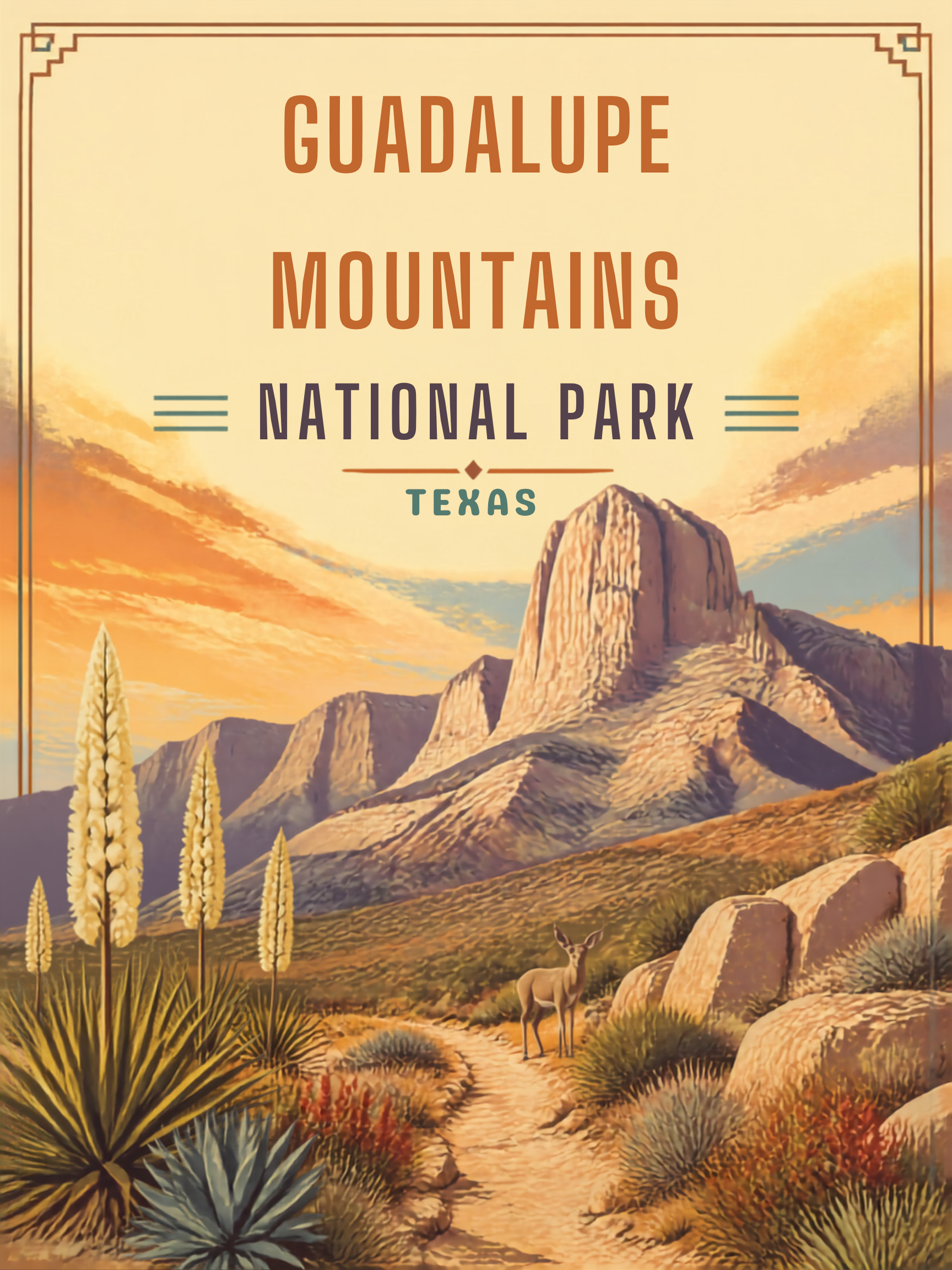
Welcome to Guadalupe Mountains National Park, home to the highest peak in Texas, diverse desert ecosystems, dramatic canyons, and rugged mountain wilderness. Located in remote West Texas near the border of New Mexico, the park protects one of the world’s best exposed fossil reefs while offering some of the finest hiking and backcountry opportunities in the American Southwest.

Did You Know?
- The largest exposed Permian fossil reef on Earth is located in Guadalupe Mountains.
- Buffalo Soldiers helped map and protect the area during the late 1800s.
- Guadalupe Peak rises to 8,751 feet, making it the highest point in Texas.
- The park preserves remarkably diverse ecosystems ranging from Chihuahuan Desert lowlands to high-elevation pine forests.

My Personal Experience
I combined my one and only visit to Guadalupe Mountains National Park with nearby Carlsbad Caverns in late September 2010. For whatever reason, I hardly have any recollection of what I did that day. I know that I spent the day in the park and stopped by the Pine Springs Visitor Center. My notes simply say, “visited Guadalupe Mountains,” but the pictures I took show that I must have done a hike near the visitor center. I also took pictures of Guadalupe Peak, the highest peak in the State of Texas.
I clearly need to return, this time with my wife, and hopefully the next edition of this guide will contain a much more detailed personal story.

Basic Facts
Address:
Guadalupe Mountains National Park
400 Pine Canyon Drive
Salt Flat, TX 79847
Operation Hours and Seasons:
The park is open year-round, 24 hours a day.
Visitors:
Over 200,000 per year (2022)
Entrance Fees:
- Private Vehicle: $10.00 (admits one private, non-commercial vehicle and all its occupants for seven days)
- Per Person: $7.00 (when entering on foot or bicycle, valid for seven days)
Website:
nps.gov/gumo
Map:
nps.gov/gumo/planyourvisit/maps.htm
Additional Information:
For additional local information, visit visitguadalupemountains.com.

Best Time to Visit
Spring is one of the best seasons to visit. Temperatures are mild, desert flora blooms and hiking conditions are excellent. Fall is another outstanding periods with cooler temperatures and stable weather. McKittrick Canyon is great for seeing fall foliage.
Summers are extremely hot making strenuous hikes during midday dangerous. Climate in winter is mild, but this season often brings high winds and potential snow or ice at higher elevations.

Recommended Time
1 Day: Enough time for one major hike such as Guadalupe Peak Trail or Devil’s Hall Trail plus scenic stops around Pine Springs and the visitor center.
2-3 Days: Ideal for exploring both Pine Springs and McKittrick Canyon while adding additional hikes and scenic viewpoints.

Getting There
The closest major city is El Paso, Texas. From El Paso, take US-62/180 East to the park entrance. Nearby towns are Carlsbad, NM and Van Horn, TX. The park is extremely remote, and services become limited quickly outside nearby gateway communities.

Weather
Guadalupe Mountains National Park experiences dramatic elevation and temperature changes
- Spring (March to May): 40s–70s°F (4–21°C). Comfortable hiking conditions with occasional strong winds.
- Summer (June to August): 70s–90s°F (21–32°C) at lower elevations. Extremely hot desert conditions with cooler mountain temperatures.
- Fall (September to November): 40s–70s°F (4–21°C). Generally stable weather and ideal hiking conditions.
- Winter (December to February): 30s–50s°F (-1–10°C). Cold temperatures and occasional snow at higher elevations.
Strong winds are common year-round, especially near Guadalupe Peak.

Hiking
Guadalupe Mountains contains some of the best hiking in Texas and the Southwest.
Easy:
- Pinery Trail – 0.75 mile round trip: Visit the ruins of a Butterfield Overland Mail stagecoach station.
- McKittrick Canyon Nature Trail – 0.9 mile round trip: Short interpretive walk with excellent scenery.
Moderate:
- Devil’s Hall Trail – 4.2 miles round trip: Features a fun rock scramble through a narrow canyon and ends at a natural rock formation known as Devil’s Hall.
- Smith Spring Loop Trail – 2.3 miles loop: Beautiful desert oasis with surprisingly lush vegetation.
Strenuous:
- Guadalupe Peak Trail – 8.4 miles round trip: The park’s signature hike climbs nearly 3,000 feet and rewards hikers with panoramic views stretching across West Texas and southern New Mexico. The famous stainless-steel summit pyramid marks the highest point in Texas.
- The Bowl Trail – 9.1 miles loop: One of the park’s most surprising hikes. Dense forests of pine and Douglas fir make visitors forget they are still in West Texas.
Desert hiking conditions can become dangerous quickly. Carry significantly more water than you think you need.
Backpacking
The park offers excellent backcountry wilderness opportunities. Popular backpacking areas include The Bowl, Tejas Trail, and Bush Mountain. Backcountry permits are required for overnight camping.
Guadalupe Mountains is one of the quieter and more remote backpacking parks in the Southwest, making it ideal for solitude seekers.

Scenic Drives
Unlike many Southwest parks, Guadalupe Mountains has no major scenic drive through the park interior. US-62/180 provides dramatic roadside views of El Capitan, Guadalupe Peak, and desert landscapes.

Best Viewpoints
- El Capitan Viewpoint: Classic roadside view of the park’s iconic limestone formation
- Guadalupe Peak Summit: Panoramic views across Texas and New Mexico
- Hunter Peak: Spectacular wilderness scenery
- McKittrick Canyon: Especially beautiful during fall foliage season

Wildlife Viewing
Look for mule deer, elk, coyotes, black bears (rare), mountain lions (very rare), and various bird species. The park’s elevation changes create unusually diverse habitats for West Texas.

Photography
Guadalupe Mountains is excellent for landscape photography.
- Golden Hour: Warm desert light beautifully highlights: limestone cliffs, rugged ridges, and desert vegetation
- Fall Photography: McKittrick Canyon becomes one of the best fall foliage destinations in Texas.
- Night Photography: The park’s remote location offers outstanding dark skies for: Milky Way photography and astrophotography.
- Storm Photography: Passing desert storms can create dramatic lighting and cloud formations around the mountains

Horseback Riding
Sixty percent of the park’s trails are open to stock use. Visitors must bring their own horse as there are no commercial riding concessions within or near the park. Check the park’s website for an overview of trails: www.nps.gov/thingstodo/gumo_trailrides.htm.
You must obtain a free Wilderness Use Permit at the Pine Springs Visitor Center to document your planned route, number of riders, and number of stock.

General Aviation
Because the park sits in one of the least populated regions of the United States, a rental car is essentially mandatory. El Paso, Texas has to most reliable rental car options while options in the close town of Carlsbad, New Mexico are rather limited.
El Paso International Airport (KELP) in El Paso, TX:
- 104 miles to the west of the park
- Longest runway: 12,020 feet
- 100LL available
Cavern City Air Terminal Airport (KCNM) in Carlsbad, NM:
- 49 miles to the northeast of the park
- Longest runway: 7,854 feet
- 100LL available
Flying in this region requires attention to mountainous terrain, military restricted airspace, high density altitude, strong winds and turbulence, extreme desert heat, and proximity to the Mexican border. However, the desert mountain scenery is spectacular from the air.

Nearby Attractions
- Carlsbad Caverns National Park: Visit this nearby National Park, walk the Big Room trail and watch the bats leave the caverns at sunset.
- Sitting Bull Falls Recreation Area: Explore a desert oasis and walk a trail to a 150-foot waterfall in the Lincoln National Forest
- White Sands National Park: Drive the Dunes Drive and hike the gypsum dunes
- Lincoln National Forest: Forested mountains and cooler temperatures nearby

Important Tips
- Carry More Water Than You Think You Need: The combination of desert climate, high elevation, and steep trails can lead to dehydration surprisingly quickly. Many experienced hikers carry at least one gallon of water per person for longer hikes.
- Start Early: Most major hikes offer little shade. Beginning before sunrise is often the safest and most comfortable option, particularly during spring and summer.
- Watch the Wind: Guadalupe Mountains is famous for strong winds. Gusts exceeding 50 mph are not uncommon, and conditions near Guadalupe Peak can become challenging even on otherwise pleasant days.
- Don’t Underestimate the Elevation Gain: Several trails climb thousands of feet in a relatively short distance. Guadalupe Peak Trail is physically demanding and much tougher than its mileage suggests.
- Cell Service Is Limited: Expect little or no cell coverage throughout much of the park. Download maps in advance and let someone know your hiking plans.
- Fuel Up Before Arrival: The park is extremely remote. Gas stations, restaurants, lodging, and grocery stores are limited once you leave Carlsbad, Van Horn, or El Paso.
- Check Weather Forecasts Carefully: Conditions can vary dramatically between the desert floor and higher elevations. A warm day at Pine Springs can mean cold temperatures, clouds, or even snow on Guadalupe Peak.
- Respect Wildlife: Black bears and mountain lions are rarely seen but do inhabit the park. More commonly, hikers encounter mule deer, elk, rattlesnakes, and other desert wildlife.
- Backcountry Preparation Is Essential: Many trails are long, rugged, and lightly traveled. Carry navigation tools, extra water, layers, food, and emergency supplies
Guadalupe Mountains National Park is one of the most underrated and least appreciated mountain parks in the United States. The combination of desert landscapes, towering limestone peaks, fossil reefs, deep canyons, and wilderness solitude creates a distinctly rugged Southwest experience. Whether you hike to the highest point in Texas, explore colorful McKittrick Canyon, or simply admire the mountains rising dramatically from the desert floor, Guadalupe Mountains rewards visitors looking for adventure far away from the crowds.


