Western Region
REDWOOD NATIONAL AND STATE PARKS
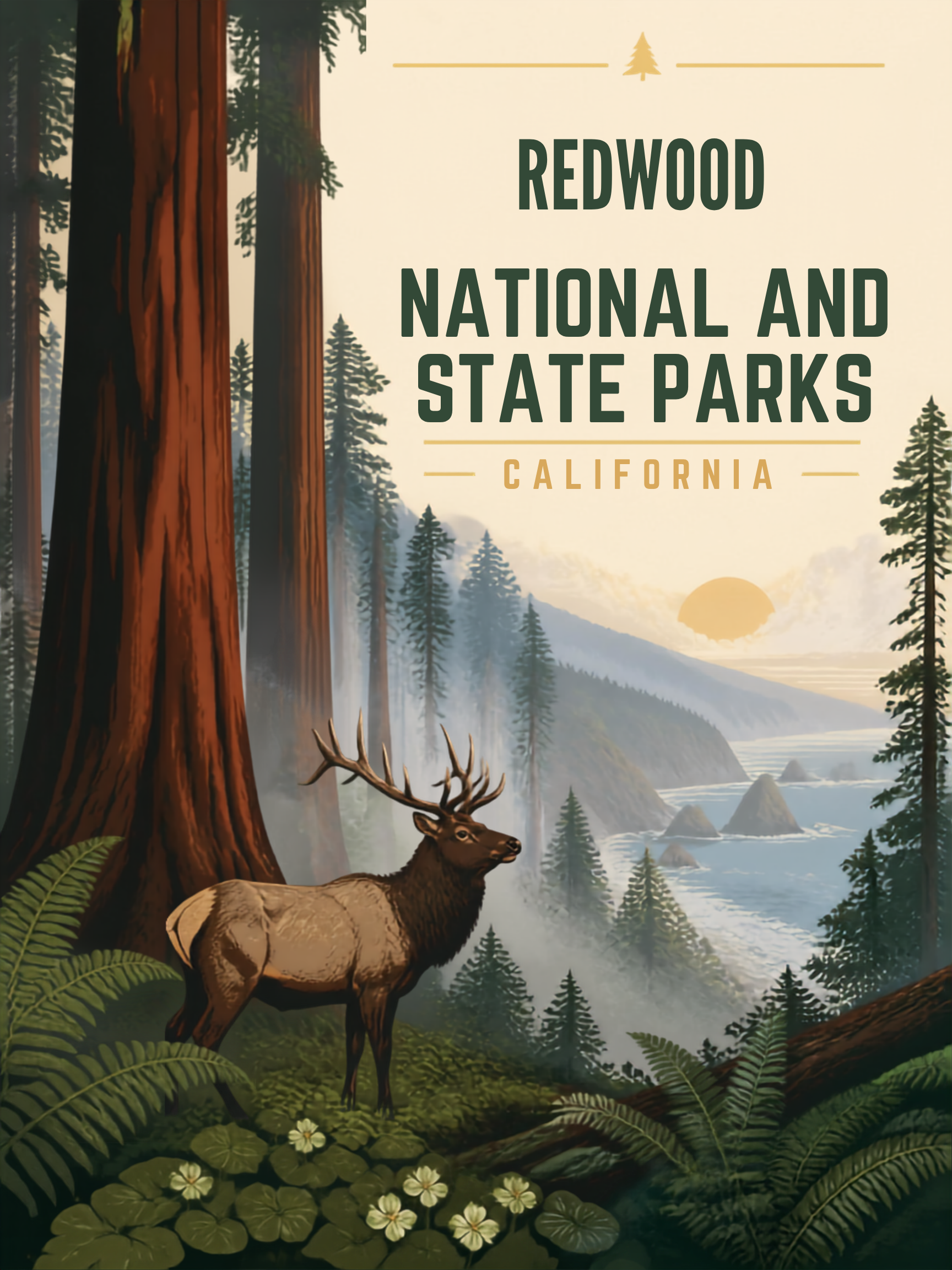
Welcome to Redwood National and State Parks in Northern California, home to some of the tallest and oldest trees on Earth. Towering coast redwoods dominate the misty forests along the Pacific coastline between Eureka and Crescent City.
The park system is a cooperative partnership between the National Park Service and California State Parks, protecting a vast landscape that includes Redwood National Park and three state parks: Del Norte Coast Redwoods, Jedediah Smith Redwoods, and Prairie Creek Redwoods. Together they safeguard ancient forests, wild rivers, rugged coastline, and diverse wildlife habitats.

Did You Know?
- The coast redwood genome is about nine times larger than the human genome, making it one of the largest plant genomes ever sequenced.
- Redwood National and State Parks protect nearly half of the world’s remaining old-growth coast redwoods.
- The park’s misty forests have served as filming locations for movies such as Jurassic Park: The Lost World and Star Wars: Return of the Jedi.

My Personal Experience
I scratched my plans to visit Redwood National and State Parks during my 2004 trip to the Pacific Northwest because it would have been a detour that I could not fit into my itinerary. Several years later, when I was living in San Jose, I decided to visit Crater Lake and Redwood over a long Memorial Day weekend.
The park complex includes one national park and three California state parks protecting the coast redwood trees (Sequoia sempervirens). These trees are among the most massive organisms on Earth and thrive in the humid temperate rainforest climate along the Northern California coast.
During my visit, I mostly drove along U.S. Highway 101, which connects multiple park areas and trailheads. I stopped for several short hikes, including a visit to the Lady Bird Johnson Grove and the tide pools along the Pacific coast. Even without hiking deep into the forests, simply walking among these enormous trees leaves a lasting impression.

Basic Facts
Address:
Redwood National and State Parks
1111 Second Street
Crescent City, CA 95531
Operation Hours and Seasons:
The park is open year-round, 24 hours a day.
Visitors:
Over 500,000 per year (2022)
Entrance Fees:
There is no entrance fee for Redwood National Park areas. Some developed areas in the associated California State Parks may charge day-use fees.
Website:
nps.gov/redw
Map:
nps.gov/redw/planyourvisit/maps.htm
Additional Information:
For additional local information, visit visitredwoods.com.

Best Time to Visit
Late spring through early fall offers the most reliable weather and easier trail access. May and September are particularly pleasant months, with fewer crowds than peak summer. Winters tend to be rainy but still provide beautiful misty forest scenery.

Recommended Time
1 Day: Drive scenic routes such as U.S. 101 or Newton B. Drury Scenic Parkway and explore several short trails.
2-3 Days: Allows time to explore both the northern and southern sections of the park complex, hike deeper into the forests, and visit the coastline.

Getting There
The closest major city is Eureka, California.
From Eureka, drive north on U.S. Highway 101 toward Crescent City. Several park areas and trailheads are located directly along the highway.

Weather
Redwood National and State Parks have a cool coastal climate influenced by the Pacific Ocean.
- Spring (March to May): 40s–60s°F (4–15°C). Mild temperatures with occasional rain and blooming wildflowers.
- Summer (June to August): 50s–70s°F (10–21°C). Often cool and foggy along the coast excellent conditions for hiking.
- Fall (September to November): 40s–60s°F (4–15°C). Clearer skies and fewer visitors.
- Winter (December to February): 40s–50s°F (4–10°C). Frequent rain but relatively mild temperatures.

Hiking
Redwood National and State Parks offer trails through ancient forests, lush canyons, and coastal landscapes.
Easy:
- Lady Bird Johnson Grove Trail – 1.5-mile loop: A beautiful trail through old-growth redwoods located high above the coast. Morning fog often creates a magical atmosphere among the towering trees.
- Fern Canyon Trail – 1 mile loop: A unique hike through a narrow canyon with walls covered in lush ferns. The scenery here famously appeared in Jurassic Park: The Lost World.
Moderate:
- Trillium Falls Trail – 2.5-mile loop: A peaceful trail through redwood forest leading to a scenic waterfall surrounded by lush vegetation.
- Tall Trees Grove Trail – 4 miles round trip: Leads to one of the most impressive groves in the park, where some of the tallest trees on Earth grow.
Strenuous:
- James Irvine Trail – 10 miles round trip: A spectacular hike through ancient redwoods and varied forest habitats that eventually leads to Fern Canyon.
- Lost Man Creek Trail – 12 miles round trip: A quieter backcountry trail following an old road through remote redwood forests and lush stream valleys.

Scenic Drives
- U.S. Highway 101: Runs directly through portions of the park complex and offers easy access to many trailheads and viewpoints.
- Newton B. Drury Scenic Parkway: A 10-mile scenic road that parallels U.S. 101 through Prairie Creek Redwoods State Park, passing thousands of acres of magnificent old-growth forest.

Best Viewpoints
- Klamath River Overlook: Offers sweeping views of the Pacific Ocean and rugged coastline.
- Lady Bird Johnson Grove: One of the best places to experience fog drifting through towering redwoods.
- Trillium Falls: A scenic waterfall surrounded by lush forest.

Wildlife Viewing
Redwood National and State Parks protect a rich mix of coastal, forest, and river ecosystems. Roosevelt elk are the park’s signature wildlife species and are frequently seen grazing in the open meadows of Prairie Creek Redwoods State Park and Elk Prairie. Visitors may also encounter black bears, coyotes, river otters, banana slugs, and a wide variety of bird species.
Along the coast, gray whales can sometimes be spotted during migration seasons, while harbor seals and sea lions are commonly seen near beaches and rocky shorelines. Early morning and evening generally offer the best wildlife viewing opportunities.

Photography
Redwood National and State Parks provide extraordinary photography opportunities.
- Ancient Redwoods: Massive trunks disappearing into coastal fog create the park’s signature images and emphasize the extraordinary scale of the trees.
- Fern Canyon: Vertical walls covered with lush ferns create one of the most unique and photogenic landscapes in the National Park System.
- Coastal Landscapes: Beaches, sea stacks, and rugged Pacific coastline provide dramatic contrasts to the dense forest scenery.
- Roosevelt Elk: Prairie Creek’s open meadows offer some of the best opportunities to photograph elk against a backdrop of ancient redwoods.

Horseback Riding
Pack animals are permitted on designated trails and certain beaches within Redwood National and State Parks. Check the parks’s website for more details: nps.gov/redw/planyourvisit/horsebackriding.htm. Visitors planning overnight trips with stock should consult the park’s pack animal use brochure, which outlines approved trails and camping locations. Guided horseback rides are available through regional outfitters such as Redwood Creek Buckarettes.

General Aviation
Two nearby airports provide convenient access to the park:
Jack McNamara Field (KCEC) in Crescent City, CA:
- Best option for visiting the northern sections of the parks
- Longest runway is 5,000 ft
- 100LL available
- Rental cars available
California Redwood Coast-Humboldt County Airport (KACV) in Arcata/Eureka, CA:
- Best option for visiting the southern sections
- Longest runway is 6,046 ft
- 100LL available
- Rental cars available
Coastal fog is the primary aviation challenge in this region and can develop rapidly, even during summer. Marine layers frequently affect both airports, particularly during morning hours. Pilots should carefully review weather conditions, alternates, and instrument approach options before departure.

Nearby Attractions
- Humboldt Redwoods State Park: Home to the famous Avenue of the Giants, one of California’s most scenic drives through old-growth redwood forests.
- Trinidad: A picturesque coastal town known for its beaches, harbor views, and excellent whale-watching opportunities.
- Ferndale: A beautifully preserved Victorian town that offers a glimpse into Northern California’s nineteenth-century history.
- Jedediah Smith Redwoods State Park: Famous for some of the most pristine old-growth redwood groves and scenic drives in the entire redwood region.

Important Tips
- Fog & Rain: Weather can change quickly along the coast. Waterproof clothing is recommended year-round.
- Elk Safety: Roosevelt elk may appear calm but can be unpredictable, especially during the fall rut. Maintain a safe distance at all times.
- Scenic Drives: Several of the most beautiful roads, including Newton B. Drury Scenic Parkway and Howland Hill Road, are attractions in their own right and should not be rushed.
- Tide Awareness: Visitors exploring beaches and tide pools should check tide tables and ocean conditions before heading out.
- Cell Coverage: Mobile service can be limited in forested and coastal areas. Download maps before arriving.
Redwood National and State Parks offer one of the most awe-inspiring forest landscapes on Earth. Walking among these towering trees some more than 2,000 years old is an experience that makes visitors feel both humbled and inspired. Whether you are hiking beneath ancient redwood canopies, exploring fern-covered canyons, or enjoying dramatic Pacific coastline views, this remarkable park system showcases the natural grandeur of Northern California.


