Rocky Mountain Region
ROCKY MOUNTAIN NATIONAL PARK
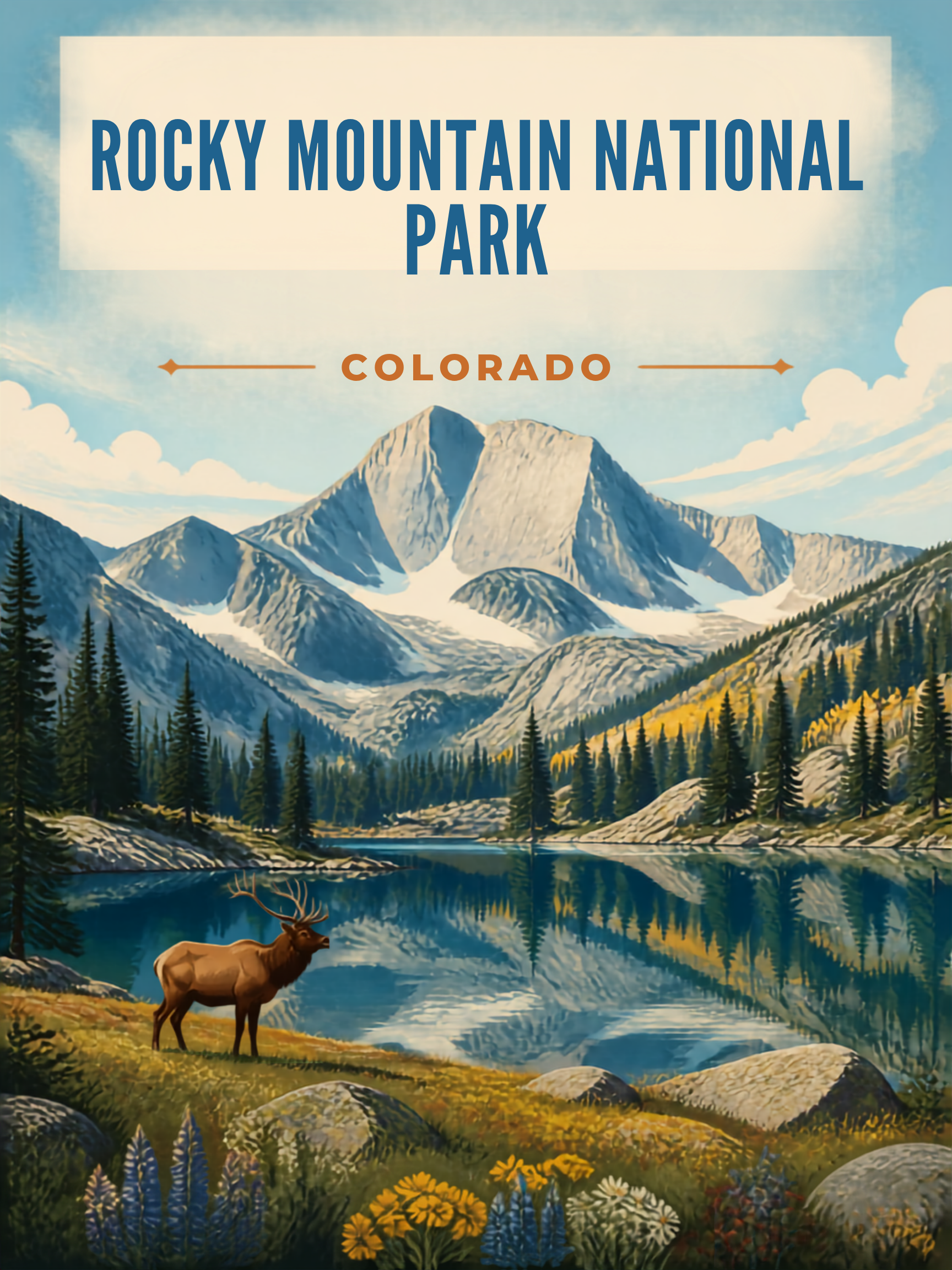
Welcome to Rocky Mountain National Park, a stunning expanse of alpine landscapes, soaring peaks, and pristine lakes in northern Colorado. The park is a crown jewel of the American West, drawing more than 4.5 million visitors annually with its sweeping vistas, diverse ecosystems, and endless recreational opportunities.
From lush montane valleys to windswept tundra, Rocky Mountain National Park showcases the dramatic elevation range of the Rockies with peaks topping out above 14,000 feet. It is a place to hike, climb, watch wildlife, and simply breathe in the mountain air.
Did You Know?
- Rocky Mountain National Park contains 77 named mountain peaks exceeding 12,000 feet in elevation.
- Trail Ridge Road reaches 12,183 feet and is the highest continuous paved road in the United States.
- More than one-third of the park lies above the tree line in the alpine tundra ecosystem.
- The park protects over 355 miles of hiking trails.
- Longs Peak, at 14,259 feet, is the highest mountain within the park.
My Personal Experience
The first time I drove Trail Ridge Road, John Denver’s “Rocky Mountain High” was stuck in my head and perhaps that’s unavoidable. Ever since I was a child visiting the Austrian Alps with my parents, I’ve thought of the mountains as my quiet refuge. Rocky Mountain National Park feels like that kind of place, though in peak season it is far from quiet! But if the mountains are calling, I must go. Memorial Day through mid-October is your chance to drive Trail Ridge Road, a 48-mile highway crossing the park east to west. It is the highest continuous paved road in the United States, cresting at 12,183 feet. Even in July, I found snow at the Alpine Visitor Center and weather that shifted by the minute. But the panoramic views were unforgettable and so was the wildlife. On that first trip I saw bull elk, bighorn sheep, deer, and even a coyote and a marmot. I might have seen an eagle fly – Rocky Mountain High – and…. back in your head.
Another visit over Thanksgiving weekend was different entirely. My wife and I hiked to Bear Lake, which was frozen solid. Some brave souls were walking across the ice but we were not! Instead, we kept to the trail and were rewarded with a moose sighting as the daylight faded.
If it’s your first visit in summer, I recommend driving Trail Ridge Road for the full alpine experience, then picking a hiking trail suited to your fitness level. With over 355 miles of trails, there is truly something for everyone. Remember, though: park elevations range from 7,500 to 12,000+ feet. Even fit visitors from lower elevations aka “flatlanders” may feel the effects of altitude. Drink plenty of water and take it slow.
Basic Facts
Address:
Rocky Mountain National Park
1000 US Hwy 36
Estes Park, CO 80517
Operation Hours and Seasons:
The park is open year-round, 24 hours a day. Some facilities and roads are closed in winter due to snow.
Visitors:
Over 4.5 million per year (2022)
Entrance Fees:
- Private Vehicle: $35.00 (admits one private, non-commercial vehicle and all its occupants for one day)
- Per Person: $15.00 (when entering on foot or bicycle, valid for one day)
Timed entry: From mid-May to mid October you need to make a timed entry reservation if you want to enter the park between 9am – 2pm. The timed entry does not include access to Bear Lake Road. If you would like access to Bear Lake Road as well, you would need the Timed Entry+ to enter between 5am – 6pm. Reservations can only be made on recreation.gov. Make your reservation in advance as only a limited amount of reservation is made available at 7pm Mountain Time the day before your arrival date. There is a $2 non-refundable processing fee and you can arrive within a two-hour window. Once you are in the park, you can stay as long as you like
Website:
nps.gov/romo
Map:
nps.gov/romo/planyourvisit/maps.htm
Additional Information:
For additional local information, visit visitestespark.com.
Best Time to Visit
Summer (June–August): The most popular season. Trail Ridge Road is fully open, hiking conditions are excellent, and nearly all visitor facilities are operating. Expect crowds, particularly around Bear Lake and Trail Ridge Road.
Fall (September–October): Many visitors consider this the best time to visit. Temperatures are pleasant, crowds diminish, and elk bugling season provides exceptional wildlife-viewing opportunities.
Spring (April–May): Lower elevations begin to thaw and wildflowers emerge. However, significant snow can remain at higher elevations and some trails may still require winter equipment.
Winter (November–March): A completely different experience. Snowshoeing, cross-country skiing, winter hiking, and wildlife viewing become the primary activities. Trail Ridge Road closes for the season, but the park becomes quieter and more peaceful.
Recommended Time
1 Day: Drive Trail Ridge Road, visit Bear Lake, stop at the Alpine Visitor Center, and complete a short hike such as Bear Lake or Sprague Lake.
2-3 Days: The ideal amount of time for most visitors. Explore both the Estes Park and Grand Lake sides of the park, hike several trails, and spend time viewing wildlife in Moraine Park and Horseshoe Park.
Getting There
The closest major city is Denver, Colorado (about 70 miles). From Denver, follow US-36 West to Estes Park, which serves as the main eastern gateway to the park. On the western side, Grand Lake provides access to a quieter entrance.
Weather
Rocky Mountain National Park experiences varied weather throughout the year:
- Spring (March to May): 30s to 60s°F (0-15°C). Snow begins to melt, and wildflowers bloom.
- Summer (June to August): 60s to 80s°F (15-27°C). Mild weather with clear skies; ideal for hiking and outdoor activities.
- Fall (September to November): 30s to 60s°F (0-15°C). Crisp, clear days with vibrant fall foliage.
- Winter (December to February): 20s to 40s°F (-6 to 4°C). Cold with heavy snowfall; ideal for winter sports.
Rocky Mountain National Park experiences significant temperature fluctuations between day and night throughout the year. It’s advisable to check the specific weather forecast before planning a trip and to be prepared for sudden changes in weather conditions.
Hiking
Rocky Mountain National Park offers a variety of trails for all levels:
Easy:
- Bear Lake Trail – 0.6 mile loop: One of the park’s most popular and accessible walks. The trail circles beautiful Bear Lake and offers spectacular reflections of Hallett Peak and the surrounding mountains. Because of its short length and minimal elevation gain, it is an excellent introduction to Rocky Mountain National Park and suitable for nearly all visitors.
- Sprague Lake Trail – 0.8 mile loop: This easy, mostly level trail circles Sprague Lake and offers some of the best mountain reflections in the park. The trail is particularly beautiful at sunrise when the surrounding peaks are reflected in the calm water. It is also one of the park’s most accessible trails.
Moderate:
- Emerald Lake Trail – 3.6 miles round trip: One of the signature hikes in Rocky Mountain National Park. Starting at Bear Lake, the trail passes Nymph Lake and Dream Lake before reaching Emerald Lake beneath the dramatic cliffs of Hallett Peak and Flattop Mountain. The scenery improves continuously along the route, making it one of the most rewarding moderate hikes in the park.
- Gem Lake Trail – 3.4 miles round trip: This trail climbs steadily through unusual granite formations and ponderosa pine forest to Gem Lake, a small mountain lake tucked beneath rocky cliffs. The route also offers excellent views of Estes Park and the surrounding foothills.
Strenuous:
- Longs Peak Trail – 14.5 miles round trip: TThis route leads to the summit of Longs Peak, the park’s highest mountain at 14,259 feet. The Keyhole Route is a serious mountaineering objective that requires excellent fitness, careful planning, and favorable weather conditions. Successful hikers are rewarded with some of the most spectacular views in the Rocky Mountains.
- Sky Pond Trail – 9 miles round trip: One of the finest hikes in the park. The trail passes Alberta Falls, The Loch, Timberline Falls, and Lake of Glass before reaching Sky Pond, a spectacular alpine lake surrounded by towering cliffs and spires. The final section requires some scrambling near Timberline Falls, but the scenery is among the best in Colorado.
Climbing
Rocky Mountain National Park is world-renowned for technical climbing and mountaineering. From granite walls in Lumpy Ridge to alpine routes on Longs Peak, the park offers challenges for all skill levels. Permits and careful preparation are essential.
Scenic Drives
- Trail Ridge Road: The signature drive of Rocky Mountain National Park. Stretching 48 miles across the park, the road climbs above the tree line and traverses alpine tundra before descending toward Grand Lake. Numerous overlooks provide spectacular views of mountains, valleys, and wildlife.
- Old Fall River Road: This historic one-way gravel road climbs to the Alpine Visitor Center via a series of tight switchbacks and provides a slower, more intimate experience of the park.
- Bear Lake Road: One of the most heavily used roads in the park, providing access to Bear Lake, Moraine Park, Sprague Lake, and several of the park’s most popular trailheads.
Best Viewpoints
- Alpine Visitor Center: One of the highest visitor centers in the National Park System and an outstanding location for viewing alpine tundra and distant mountain ranges.
- Many Parks Curve: A classic overlook that provides expansive views of Estes Park, Moraine Park, and Longs Peak.
- Forest Canyon Overlook: Offers one of the most dramatic views along Trail Ridge Road and showcases the immense scale of the park’s alpine landscape.
- Bear Lake: One of the most photographed locations in the park and a beautiful place to experience sunrise.
- Farview Curve: An excellent overlook for appreciating the vast mountain scenery and elevation changes that define Rocky Mountain National Park.
Wildlife Viewing
Rocky Mountain National Park offers some of the best wildlife viewing in Colorado. Elk are the park’s most famous residents and are frequently observed in Moraine Park, Horseshoe Park, and the meadows surrounding Estes Park. Mule deer and bighorn sheep are commonly seen throughout the park, while moose have become increasingly common near wetlands, lakes, and willow thickets. Visitors may also encounter marmots, pikas, coyotes, and black bears. Early mornings and evenings generally provide the best wildlife-viewing opportunities, particularly during the fall elk rut.
Photography
Capture the stunning alpine landscapes and diverse wildlife:
- Golden Hour: Soft sunlight enhances the dramatic scenery of the mountains and valleys. Sunrise and sunset offer the best light (no s**t). Location like Sprague Lake, Bear Lake, and Moraine Park are ideal for sunrise.
- Night Photography: The clear skies offer excellent opportunities for photographing the Milky Way and stars. New moon nights might be perfect.
Please find some ideas in the table:
| Location | Subject/Scene | Tips |
| Bear Lake | Reflections, fall foliage | Great at sunrise. Arrive early. |
| Sprague Lake | Alpenglow, lake reflections | ADA-accessible, good for sunrise/ sunset. |
| Moraine Park | Elk herds, meadow scenes | Best in fall rut season (Sept–Oct). |
| Trail Ridge Road | Panoramas, tundra, wildflowers | Shoot at pullouts. Ideal for dramatic skies. |
| Dream & Emerald Lake | Alpine lakes, peaks | Use wide-angle lens. Best at sunrise. |
| Alberta Falls | Waterfalls, long exposure | Use tripod. Go early to avoid people. |
| Sheep Lakes | Bighorn sheep (spring/summer) | Bring telephoto lens and patience. |
| Milner Pass | Continental Divide sign, reflection | Good stop for a composed landmark shot. |
Horseback Riding
Do you like to ride a horse? A mule, a pony, a burro or a llama? Rocky Mountain National Park is your place: These animals are all allowed on park trails. C One stable is within park bounders: Glacier Creek Stables and there are many more outside the park. About 80% of the park’s trails (that’s approximately 260 miles) are open to commercial and private use. heck the park’s website for details including rules and safety information: nps.gov/romo/planyourvisit/horses.htm.
General Aviation
Rocky Mountain National Park is one of the premier destinations in the United States for pilots who enjoy mountain flying. Several airports provide convenient access to the park, although visitors should plan on renting a car regardless of which airport they choose.
East Entrance (Estes Park) – All airports sit at about 5,000 foot elevation.
Boulder Municipal Airport (KBDU) in Boulder, CO:
- One of the most convenient airports for visitors approaching the park from the east.
- Approximately 45 miles from Estes Park
- Longest runway: 4,100 feet
- 100LL available
- Full-service FBO
- Rental cars available with advance arrangements
Vance Brand Airport (KLMO) in Longmont, CO:
- A popular option for general aviation pilots visiting Rocky Mountain National Park.
- Approximately 35 miles from Estes Park
- Longest runway: 4,800 feet
- 100LL available
- Full-service FBO
- Rental cars available
Northern Colorado Regional Airport (KFNL) in Loveland, CO:
- An excellent choice for pilots seeking a longer runway and additional services.
- Approximately 45 miles from Estes Park
- Longest runway: 8,500 feet
- 100LL available
- Multiple FBOs
- Rental cars available
West Entrance (Grand Lake)
Granby-Grand County Airport (KGNB) – Granby, CO:
- The most convenient airport for visitors entering the park through the Grand Lake entrance.
- Approximately 20 miles from Grand Lake
- Longest runway: 5,000 feet
- Elevation: 8,207 feet
- 100LL available
- Rental cars available with advance planning
Do you want to fly with the big dogs? Consider Denver International (KDEN), about 75 miles south east of the Estes Park entrance.
Denver International Airport (KDEN) – Denver, CO:
- The best alternative for visitors who prefer airline service or require extensive rental car options.
- Approximately 75 miles from Estes Park
- Longest runway: 16,000 feet
- Extensive rental car availability
- Convenient access to the Colorado Front Range
Pilots flying to Rocky Mountain National Park should be comfortable operating in a mountain environment. Density altitude is a significant factor throughout the region, particularly during the summer months when temperatures can dramatically reduce aircraft performance. Even airports along the Front Range sit at elevations around 5,000 feet, while Granby-Grand County Airport exceeds 8,000 feet.
Mountain weather can change rapidly. Strong winds, turbulence, mountain wave activity, and afternoon thunderstorms are common during the warmer months. Pilots should carefully review weather briefings and be prepared for conditions to differ substantially between airports and nearby mountain passes.
The reward is exceptional scenery. Flights along Colorado’s Front Range and around Rocky Mountain National Park provide spectacular views of alpine lakes, snow-capped peaks, deep valleys, and some of the highest terrain in the continental United States. For many pilots, a visit to Rocky Mountain National Park is one of the highlights of mountain flying in North America.
Nearby Attractions
- Estes Park: The primary eastern gateway to the park and a charming mountain town offering lodging, restaurants, shopping, and outdoor recreation.
- Grand Lake: A quieter gateway community on the park’s western side and home to Colorado’s largest natural lake.
- Indian Peaks Wilderness: A spectacular wilderness area south of the park featuring alpine lakes, rugged peaks, and outstanding hiking opportunities.
- Mount Blue Sky Scenic Byway: One of North America’s highest paved roads and an excellent addition to a Colorado mountain road trip.
- Boulder: A vibrant university town known for outdoor recreation, restaurants, and access to the Front Range.
Important Tips
- Secure Timed Entry Reservations Early: Reservations frequently sell out during peak season, especially for Bear Lake Road access.
- Start Early: Parking areas at Bear Lake and other popular trailheads fill quickly, often before sunrise.
- Respect the Altitude: Many visitors underestimate the effects of elevation. Stay hydrated, pace yourself, and allow time to acclimate.
- Prepare for Rapid Weather Changes: It is possible to experience sunshine, rain, wind, snow, and freezing temperatures on the same day.
- Carry Layers: Even during summer, temperatures above the tree line can be surprisingly cold.
- Watch for Wildlife: Maintain safe distances from all animals and never approach elk, moose, bears, or bighorn sheep.
Rocky Mountain National Park captures everything people imagine when they think of the American Rockies: towering peaks, alpine lakes, wildlife-filled meadows, and roads that climb above the clouds. Whether you are driving Trail Ridge Road, hiking to a remote alpine lake, photographing elk in Moraine Park, or standing on a windswept tundra ridge at over 12,000 feet, the park delivers unforgettable mountain experiences.
For me, Rocky Mountain National Park brings back memories of the Alps and reinforces something I have felt since childhood. Mountains have a unique ability to make us feel both small and inspired at the same time. If the mountains are calling, Rocky Mountain National Park is one of the best places in America to answer that call.


