Rocky Mountain Region
YELLOWSTONE NATIONAL PARK
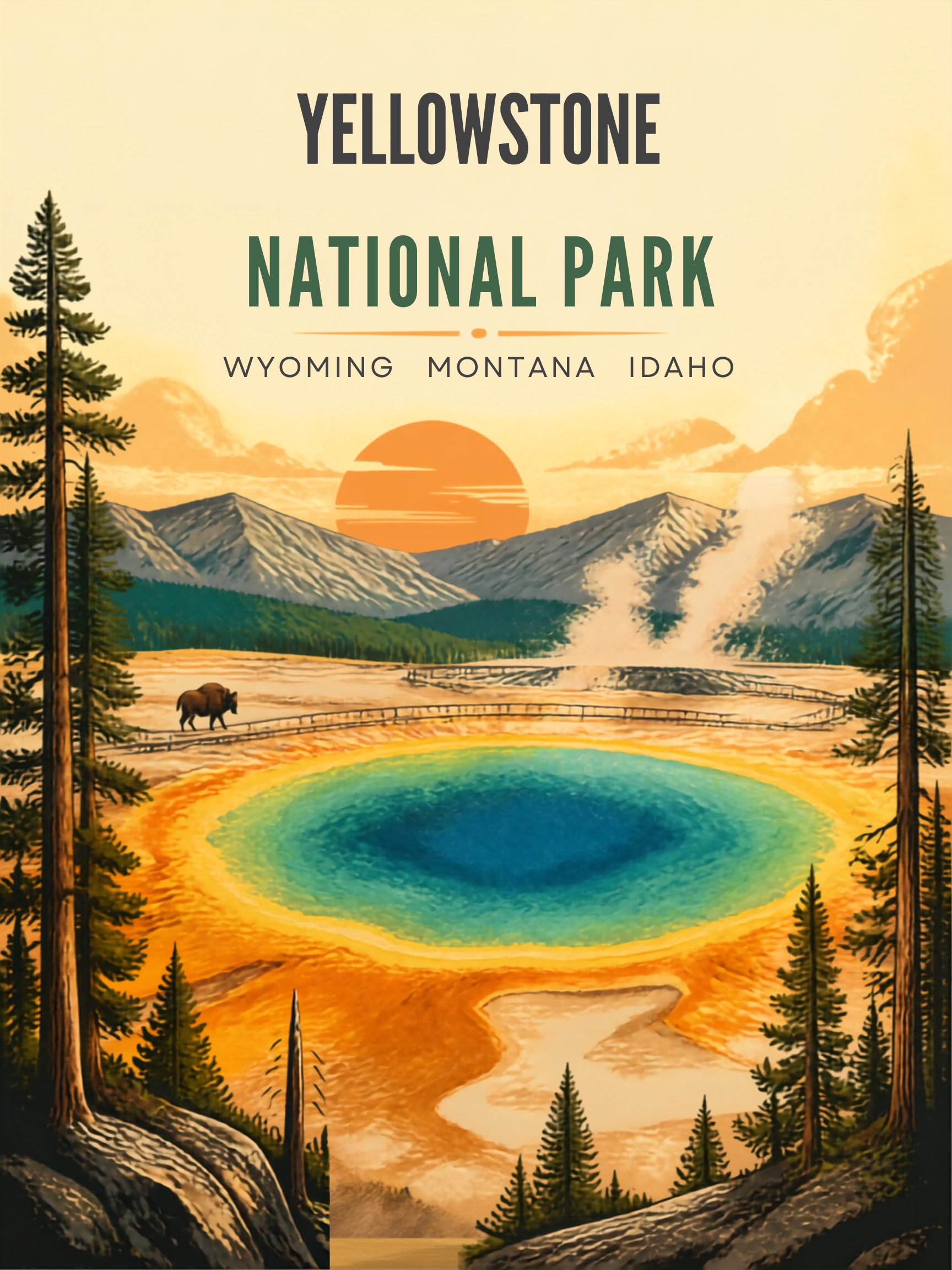
Welcome to Yellowstone National Park, the world’s first national park, located primarily in northwest Wyoming but extending into Montana and Idaho. Famous for its geothermal features, diverse ecosystems, and abundant wildlife, Yellowstone offers an unparalleled experience. On March 1, 1872, it became the world’s first national park marking the beginning of what is often called America’s best idea.
Did You Know?
- Yellowstone became the world’s first national park on March 1, 1872, establishing a model that would later inspire national parks around the globe.
- Roughly half of all known geothermal features on Earth are located within Yellowstone National Park, including geysers, hot springs, mud pots, and fumaroles.
- Yellowstone sits atop a massive volcanic system commonly referred to as the Yellowstone Caldera. The most recent major eruption occurred approximately 640,000 years ago.
- The park covers more than 2.2 million acres, making it larger than the states of Rhode Island and Delaware combined.
- Yellowstone is home to the largest free-roaming bison herd in the United States and is one of the few places in North America where bison have lived continuously since prehistoric times.
My Personal Experience
If you ask me what left a lasting impression Old Faithful or Grand Prismatic Spring I will answer: bison! Ever since my 6th-grade English teacher showed us slides of his trip to Yellowstone, I had dreamed of seeing a bison in the wild. As the largest land mammal in North America, encountering these magnificent creatures up close left me speechless. I couldn’t help but imagine what the West must have looked like when millions of them roamed in vast herds.
Yellowstone is the largest national park in the lower 48, bigger than Delaware and Rhode Island combined. On my first visit, I made the mistake of planning too little time. Driving through the park, stopping for wildlife, and exploring geologic features takes far longer than expected. I didn’t repeat that mistake on my next visit. If possible, plan to spend at least four days here.
Like most visitors, I began my trips from towns near the east and south entrances. For a quieter experience, consider the north entrance. The lake and canyon areas also tend to feel less crowded than the geyser basins, especially around Old Faithful. I never stayed overnight inside the park, but I did peek into the Old Faithful Inn. It’s stunning, but expect steep prices and reservations that book up months in advance.
Basic Facts
Address:
Yellowstone National Park
WY 82190
Operation Hours and Seasons:
Open 24 hours a day, year-round. Note that many park roads close in winter.
Visitors:
Over 4 million (2022), making Yellowstone the 4th most visited national park in the U.S.
Entrance Fees:
- Private Vehicle: $35.00 (covers all occupants)
- Per Person (pedestrian, bicycle, etc.): $20.00
Website:
nps.gov/yell
Map:
nps.gov/yell/planyourvisit/maps.htm
Additional Information:
yellowstonepark.com
yellowstonenationalparklodges.com
Best Time to Visit
Spring through fall offers the best overall visitor experience.
Late spring is an excellent time for wildlife viewing as many animals emerge from winter and young wildlife begin appearing throughout the park. Snow may still affect higher elevations and some roads may remain closed.
Summer provides full access to roads, visitor facilities, hiking trails, and campgrounds. It is also the busiest season, with heavy traffic and crowded parking areas at major attractions.
Fall is arguably the best season for many visitors. Crowds begin to diminish, wildlife activity increases during the elk rut, and cooler temperatures create ideal hiking conditions.
Winter transforms Yellowstone into a completely different park. Snow coaches, snowmobiles, cross-country skis, and snowshoes become the primary modes of transportation, allowing visitors to experience the geothermal features in a spectacular winter setting.
Recommended Time
1 Day: One day allows visitors to experience only a small portion of Yellowstone. Focus on either the geyser basins around Old Faithful and Grand Prismatic Spring or the Canyon area and Yellowstone Lake.
2-3 Days: The minimum amount of time I recommend for most visitors. This allows you to explore several major regions, view wildlife, and drive most of the Grand Loop Road.
Longer stays e.g. 4-5 days are ideal for first-time visitors. This provides enough time to experience all major areas of the park, enjoy multiple wildlife-viewing opportunities, and complete several hikes without feeling rushed.
Getting There
- From the South: Take US-191 north from Jackson, WY, and consider visiting Grand Teton National Park along the way.
- From the East: Reach the park via Cody, WY, on US-20 after visiting the Buffalo Bill Center of the West.
- From the West: Drive US-20 from Idaho Falls to West Yellowstone.
- From the North: Exit I-90 at Livingston, MT, then follow US-89 south.
Weather
Spring (Mar–May): 30s–60s°F (0–20°C). Snow lingers at higher elevations; moderate temperatures ideal for hiking.
Summer (Jun–Aug): 60s–80s°F (15–27°C). Peak season for hiking and geothermal exploration.
Fall (Sep–Nov): 30s–60s°F (0–20°C). Crisp air and vibrant foliage.
Winter (Dec–Feb): 20s–30s°F (-6–0°C). Heavy snow; excellent for snowshoeing and cross-country skiing.
Hiking
Yellowstone National Park offers a variety – to be more specific more than 900 miles – of trails for all levels. Remember that many of the trails are more than 7,000 ft above sea level and many are snow-covered through late July. Plan accordingly and don’t forget that you are in bear country. Carry bear spray and know how to use it. Lastly, do not leave the trails. Taking shortcuts could lead to soil erosion and could be dangerous in hydrothermal areas as you might step on thin soil and plunge into boiling water.
Check the park’s website for any closures and pick your favorite trail(s) in any of the seven major areas:
- Mammoth Area
- Madison Area
- Tower Area
- Canyon Area
- Old Faithful
- Fishing Bridge/ Lake Village
- West Thumb / Grant Village
Here’s a tiny selection of trails you could hike:
Easy:
- Old Faithful Geyser Loop/Upper Geyser Basin (Old Faithful) – 1 mile board walk: Thetrail showcases the famous geyser Old Faithful and other geothermal features. Most visitor just check Old Faithful’s schedule, park their car, walk to the bleachers, wait for the eruption, take pictures, and leave. There is so much more to see and there are other geysers which erupt frequently. You can certainly make this easy walk and several miles strenuous trail with memories that last a lifetime.
- Mammoth Hot Springs Terraces (Mammoth Area) – 1.75 miles loop: Trail leads through the travertine terraces. Mammoth Hot Springs is a Don’t miss!
Moderate:
- Fairy Falls – 6.7 miles round trip: Trail leads to a stunning waterfall (the park’s fourth highest). Visit Grand Prismatic Spring en route.
- Elephant Back Mountain Trail – 3.6 miles round trip: An uphill hike leading to a fantastic overlook of Yellowstone Lake. The switchbacks through the forest make the climb manageable, and the views at the summit are rewarding.
Strenuous:
Specimen Ridge Trail – 17 miles one way: A long and strenuous hike offering incredible views, fossilized trees, and a high likelihood of spotting wildlife. A shuttle is required for a one-way hike, or it can be done as an out-and-back for a shorter version.
Mount Washburn (Canyon Area) – 6 miles round trip: A hike with panoramic views from the summit. Pick a clear day and you will be rewarded with distant views up to 50 miles.
Scenic Drives
- Grand Loop Road: The park’s signature drive covers approximately 142 miles and connects Yellowstone’s major attractions. The route links Mammoth Hot Springs, Tower-Roosevelt, Canyon, Lake, West Thumb, Old Faithful, Madison, and Norris.
- Lamar Valley Drive: Often called America’s Serengeti, this section of road provides some of the best wildlife-viewing opportunities in North America. Early mornings and evenings frequently reward visitors with sightings of bison, wolves, bears, elk, and pronghorn.
- Hayden Valley Drive: Located between Canyon Village and Yellowstone Lake, Hayden Valley is another premier wildlife-viewing destination and one of the best locations for observing large bison herds.
- Firehole Lake Drive: A short but rewarding drive through one of Yellowstone’s most active geothermal regions featuring geysers, hot springs, and steaming landscapes.
Best Viewpoints
- Grand Canyon of the Yellowstone: The overlooks along both rims provide some of the most dramatic scenery in the park and feature spectacular views of the Upper and Lower Falls.
- Artist Point: One of Yellowstone’s most famous viewpoints, offering a postcard-perfect view of the Lower Falls and colorful canyon walls.
- Mount Washburn: The summit provides sweeping views across much of Yellowstone and is one of the park’s finest hiking destinations.
- Grand Prismatic Spring Overlook: The elevated viewpoint reveals the remarkable colors of Yellowstone’s largest hot spring and provides one of the park’s most photographed scenes.
- Inspiration Point: Located along the Grand Canyon of the Yellowstone, this viewpoint offers another outstanding perspective of the canyon and river below.
Wildlife Viewing
Yellowstone offers the finest wildlife viewing opportunities in the lower 48 states. Visitors frequently encounter bison throughout the park, particularly in Hayden Valley and Lamar Valley. Elk are common near Mammoth Hot Springs and throughout many meadow areas, while pronghorn are frequently observed in the northern portion of the park. Black bears and grizzly bears are regularly seen during spring and early summer, especially in Lamar Valley and Hayden Valley. Wolves have become one of Yellowstone’s most sought-after wildlife sightings, although patience and a spotting scope are often required. Early mornings and evenings generally provide the best opportunities to observe wildlife activity.
Photography
Yellowstone is one of the premier photography destinations in North America.
- Wildlife Photography: Few places offer better opportunities to photograph large mammals. Bison, elk, bears, wolves, moose, pronghorn, and bighorn sheep all occur within the park. Visitors should always maintain the legally required distances from wildlife.
- Geothermal Photography: Old Faithful, Grand Prismatic Spring, Mammoth Hot Springs, and countless smaller geothermal features provide endless opportunities for creative photography. Clear blue skies often enhance the colors of the thermal pools.
- Landscape Photography: The Grand Canyon of the Yellowstone, Yellowstone Lake, Lamar Valley, and Hayden Valley provide outstanding landscape opportunities throughout the year.
- Night Photography: Yellowstone’s dark skies create excellent opportunities for astrophotography. Steam rising from geothermal features can add a unique element to nighttime images.
- Seasonal Photography: Each season offers distinct opportunities. Spring brings newborn wildlife, summer offers full access to the park, fall provides beautiful colors and wildlife activity, and winter transforms Yellowstone into a dramatic snow-covered landscape.
You can also check the website of the Old Faithful Inn for guided photo safari tours.
Horseback Riding
Horseback riding remains a traditional way to experience Yellowstone’s backcountry. Visitors bringing their own horses may use designated stock trails and must comply with National Park Service regulations, including current health documentation requirements. A current Coggins test is required, and stock use is generally limited to designated routes and backcountry areas. Official regulations are available at: nps.gov/yell/planyourvisit/horsebackriding.htm.
Several licensed outfitters operate both inside and outside the park, offering guided horseback rides, pack trips, and backcountry experiences. Reservations are strongly recommended during the summer season.
General Aviation
Yellowstone National Park is massive and GA pilots need a rental car to get around. The following airports offer reliable rental car availability.
Yellowstone Airport (KWYS) in West Yellowstone, MT:
- The most convenient airport for visitors approaching the park from the west.
- Approximately 2 miles from the West Entrance
- Longest runway: 8,400 feet
- 100LL available
- Full-service FBO
- Complimentary pilot campground available
Yellowstone Regional Airport (KCOD) in Cody, WY:
- A popular choice for visitors entering through the East Entrance.
- Approximately 55 miles from the East Entrance
- Longest runway: 8,268 feet
- 100LL available
Jackson Hole Airport (KJAC) in Jackson, WY:
- An excellent option for visitors combining Yellowstone and Grand Teton.
- Approximately 60 miles from the South Entrance
- Longest runway: 6,300 feet
- 100LL available
Pilots should pay careful attention to density altitude, as all three airports sit between roughly 5,000 and 6,500 feet above sea level. Mountainous terrain surrounds much of the region, and afternoon turbulence and thunderstorms are common during the summer months. Weather conditions can change rapidly, particularly near mountain passes. The reward is some of the most spectacular flying scenery in North America.
Nearby Attractions
- Grand Teton National Park: Located immediately south of Yellowstone, Grand Teton features dramatic mountain scenery, alpine lakes, and excellent wildlife viewing.
- Buffalo Bill Center of the West: One of the finest museums in the American West and an excellent addition to any visit through Cody.
- West Yellowstone: The busiest gateway community to Yellowstone, offering lodging, restaurants, museums, and outdoor recreation opportunities.
- National Museum of Wildlife Art: Located near Jackson, this museum houses one of the premier wildlife art collections in the world.
- Beartooth Highway: Often described as one of the most scenic drives in America, this spectacular route connects Red Lodge, Montana, with the Northeast Entrance of Yellowstone.
Important Tips
- Give Yourself More Time: Yellowstone is much larger than many visitors realize. Distances are substantial, traffic delays are common, and wildlife sightings often slow travel.
- Stay on Boardwalks: The thermal areas can be extremely dangerous. Thin crusts may conceal boiling water beneath the surface.
- Carry Bear Spray: Anyone hiking in Yellowstone should carry bear spray and know how to use it.
- Expect Wildlife Traffic Jams: Wildlife sightings frequently bring traffic to a standstill. Build extra time into your daily itinerary.
- Book Lodging Early: Accommodations inside the park often sell out many months in advance.
- Respect Wildlife Distances: Remain at least 100 yards from bears and wolves and at least 25 yards from all other wildlife.
- Start Early: Early mornings provide the best opportunities for wildlife viewing, photography, and avoiding crowds.
Yellowstone National Park is not only the world’s first national park, but also one of the most extraordinary places on Earth. Nowhere else will you find such a remarkable combination of geysers, hot springs, waterfalls, canyons, mountains, forests, and wildlife concentrated within a single protected landscape. For me, however, Yellowstone will always be about the bison. Seeing those magnificent animals in the wild fulfilled a childhood dream that began in a sixth-grade English classroom many years earlier. Whether your own lasting memory comes from a geyser eruption, a wolf sighting, a grizzly bear in the distance, or your first encounter with a bison herd, Yellowstone has a way of creating moments that stay with you long after you leave. Few places capture the spirit of America’s national parks better than Yellowstone, and every visitor should experience it at least once in their lifetime.


