Western Region
GRAND CANYON NATIONAL PARK
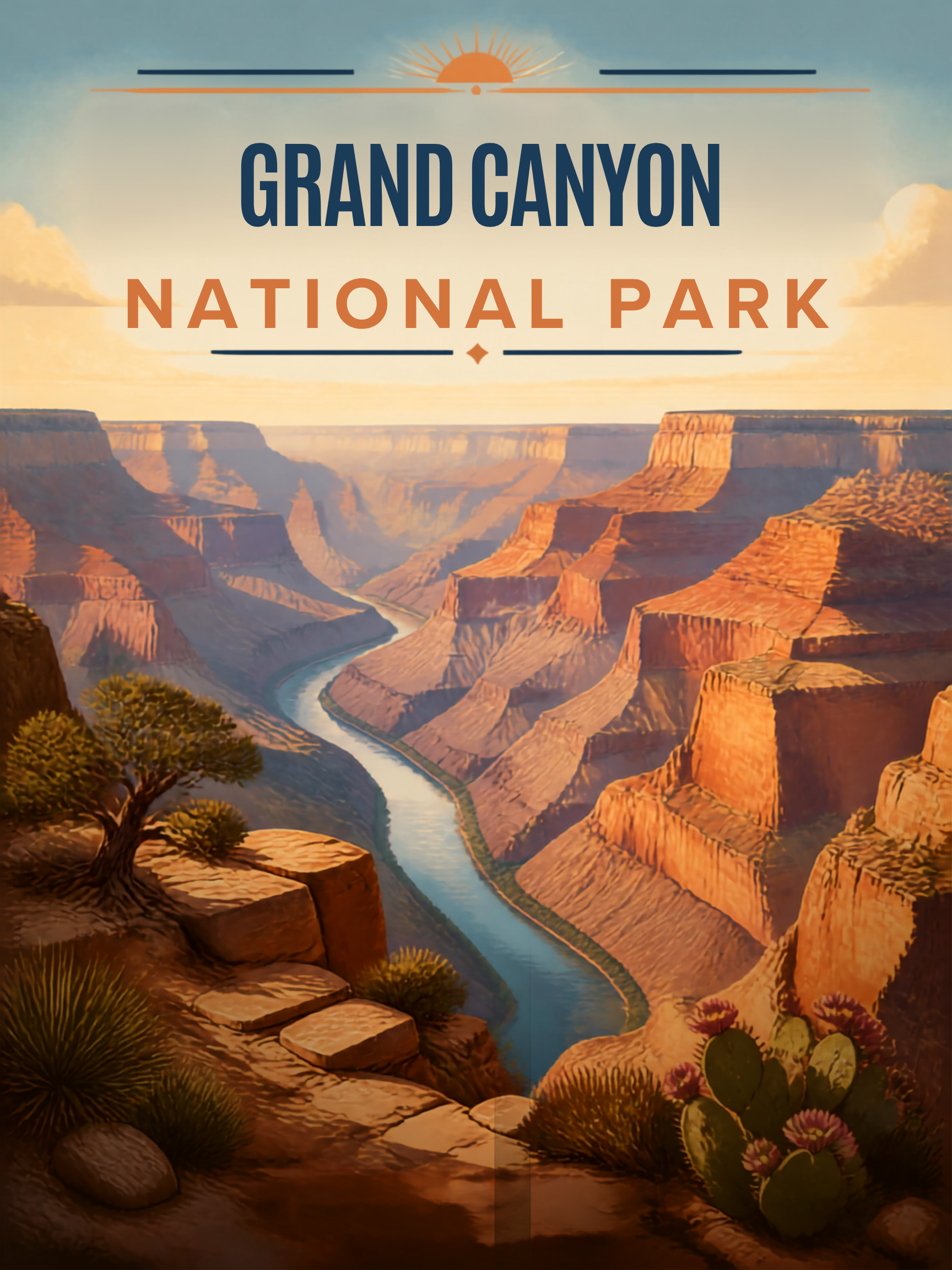
Welcome to Grand Canyon National Park, one of the most iconic and breathtaking landscapes on Earth. Carved over millions of years by the mighty Colorado River, the Grand Canyon in northern Arizona offers staggering views, spectacular geology, and some of the most dramatic scenery found anywhere in the National Park System. With its vast scale, colorful rock layers, and dizzying depths, this natural wonder inspires awe, reflection, and exploration unlike almost any other place in the world.

Did You Know?
- The Grand Canyon is approximately 277 miles long, up to 18 miles wide, and more than a mile deep.
- Nearly two billion years of geological history are exposed in the canyon’s rock layers.
- The Colorado River continues to carve and shape the canyon today.
- California condors, one of the rarest birds in North America, have been successfully reintroduced to the Grand Canyon region.
- Grand Canyon National Park is designated an International Dark Sky Park.

My Personal Experience
First-time visitors to the Grand Canyon will likely be left speechless and so was I. The first time I stood at the rim, my jaw literally dropped; I could hardly believe my eyes. What an incredible, billion-year-old “hole in the ground.”
If crowds aren’t your favorite thing, I recommend visiting the North Rim, which is significantly less crowded than the South Rim and sits about 1,500 feet higher in elevation. Roads on the North Rim may still be snow-covered in spring and can close early in fall due to weather, so plan accordingly.
I usually base myself in Kanab, Utah about an hour north of the North Rim because it also makes visits to Bryce Canyon and Zion very easy day trips. On one visit to the canyon, I was lucky enough to see California condors soaring overhead for the first time what amazing creatures. I can still hear the sound of their wingbeats against the vast canyon walls.
If you prefer metal birds, the South Rim is where most helicopter and fixed-wing tours depart. On my first trip, I booked an airplane tour, but thunderstorms over the North Rim forced us to turn back halfway through. It was one of the scarier experiences I’ve had, though I got a partial refund and a good soaking on the walk back to the car.
Despite visiting the Grand Canyon multiple times, I’ve never hiked all the way to the bottom, “next time” is always the promise. A multi-day hike to Phantom Ranch is considered a lifetime experience by many, and doing it in a single day is not recommended, even for very fit hikers. Maybe next trip I’ll try flying over it myself.
Basic Facts
Address:
Grand Canyon National Park
20 South Entrance Road
Grand Canyon, AZ 86023
Operation Hours and Seasons:
The park is open 24 hours a day, year-round. Visitor centers have seasonal hours.
Visitors:
Approximately 6 million per year (2022)
Entrance Fees:
- Private Vehicle – $35.00 admits one private, non-commercial vehicle and all its occupants for 7 days
- Per Person – $20.00
Website:
nps.gov/grca
Map:
nps.gov/grca/planyourvisit/maps.htm
Additional Information:
For additional local information, visit grandcanyoncvb.org
Important Note:
Due to high visitation, consider visiting the park in the early morning or late afternoon to avoid crowds. Check the park’s website for road and trail conditions, especially during winter.
Best Time to Visit
Many visitors consider fall the ideal season. Temperatures moderate, crowds begin to decline, and visibility is often excellent. Spring, however, is the best seasons to visit. Temperatures are pleasant along both rims, wildflowers begin to bloom, and hiking conditions are generally favorable.
Summer is the busiest season. The South Rim enjoys warm temperatures, while the inner canyon can exceed 100°F. Early starts are essential for any strenuous hiking. The South Rim remains open year-round and occasionally receives snowfall in winter that creates spectacular photographic opportunities. The North Rim is generally closed due to snow in winter.

Recommended Time
1 Day: Drive Desert View Drive, visit several overlooks, walk portions of the Rim Trail, and watch either sunrise or sunset from the South Rim.
2-3 Days: Ideal for most visitors. Explore both Desert View Drive and Hermit Road, hike below the rim, and spend time at several viewpoints throughout the day. Stay longer if you like to add South Kaibab Trail, Bright Angel Trail, and if seasonal access permits, spend a day exploring the North Rim.
Getting there
South Rim:
The closest major city is Flagstaff, Arizona. From Flagstaff, take US-180 North (or AZ-64) for about 75–80 miles to the South Rim entrance.
North Rim:
The North Rim is best accessed from Kanab, Utah, via US-89 and AZ-67. It is generally closed in winter due to snow (typically mid-October through mid-May).
Bryce Canyon and Zion National Parks are both about 1–1.5 hours from the North Rim, making them perfect companions for a larger Southwest itinerary.
Weather
The weather at Grand Canyon National Park varies significantly between the South Rim, North Rim, and inner canyon.
- Spring (Mar–May): South Rim highs 50s–70s°F (10–25°C); occasional rain. Canyon bottom remains warmer.
- Summer (Jun–Aug): South Rim 80s°F (27–32°C); inner canyon often exceeds 100°F (38°C). Heat and dry conditions make early starts essential.
- Fall (Sep–Nov): South Rim 50s–70s°F (10–25°C); cooler and less crowded, with crisp air and great lighting for photography.
- Winter (Dec–Feb): South Rim highs 30s–50s°F (-1–10°C); North Rim closes due to snow. Snow dusts the rim for stark contrast photography
Always prepare for rapid temperature changes, especially when descending into the canyon.
Hiking
The Grand Canyon offers dramatic hikes with major elevation changes. Here are some classic options:
Easy:
- Rim Trail (South Rim) – up to 13 miles: One of the best ways to experience the canyon. Visitors can walk as much or as little as they choose while enjoying continuous views along the South Rim. Numerous shuttle stops make it easy to customize the experience.
- Bright Angel Point Trail (North Rim) – 0.5 miles round trip: A short but spectacular North Rim walk leading to one of the finest overlooks in the park. The views provide an excellent appreciation of the canyon’s immense scale.
Moderate:
- South Kaibab Trail to Cedar Ridge (South Rim) – 3 miles round trip: A classic first descent below the rim. The trail offers increasingly dramatic canyon views with every switchback and provides an excellent introduction to inner-canyon hiking.
- Hermit Trail (South Rim) – 9 miles round trip: A less crowded alternative to the park’s more famous trails. The route provides solitude, interesting geology, and a glimpse into the canyon’s rugged backcountry.
Strenuous:
- Bright Angel Trail to Indian Garden (South Rim) – 9 miles round trip: One of the park’s most popular day hikes. Visitors descend deep into the canyon before reaching the shaded oasis of Indian Garden. The return climb can be demanding, especially during warm weather.
- North Kaibab Trail to Roaring Springs – 9.4 miles round trip: The only maintained trail descending into the canyon from the North Rim. The route offers dramatic scenery, excellent geology, and significantly fewer crowds than comparable South Rim hikes.
Hikes into the canyon involve significant descent and an even tougher ascent back so plan accordingly with water, permits (if overnight), and a realistic approach to temperature and exertion.
Rafting
Commercial operators offer professionally guided river trips. These are often reserved a year or two in advance.
Private river trips are subject to a weighted lottery system. Check the park’s website for a comprehensive overview of regulations.
Scenic Drives
- Desert View Drive: A 25-mile South Rim route with numerous overlooks and historic sites, ending at the Desert View Watchtower.
- Cape Royal Road: ~23 miles along the North Rim with spectacular overlooks and picnic areas.
Both drives provide dramatic perspectives of the canyon’s geological structure and ever-changing light.
Best Viewpoints
- Mather Point: One of the first viewpoints most visitors encounter and an unforgettable introduction to the canyon.
- Desert View Watchtower: Provides expansive views of the Colorado River and eastern portions of the canyon.
- Yavapai Point: Among the best locations for appreciating the canyon’s geology and immense depth.
- Hopi Point: One of the premier sunset locations on the South Rim.
- Cape Royal: The North Rim’s most spectacular overlook and one of the best viewpoints in the entire park.
- Bright Angel Point: Offers dramatic views into the canyon from the North Rim and is accessible to nearly all visitors.
Wildlife Viewing
Although the canyon itself often dominates visitors’ attention, Grand Canyon National Park supports an impressive variety of wildlife. Mule deer are commonly observed throughout the park, while elk are frequently seen near the South Rim. Bighorn sheep inhabit the canyon’s rugged slopes, and California condors occasionally soar above the rim. Coyotes, ravens, rock squirrels, and numerous bird species are common throughout the park. Early morning and evening generally provide the best wildlife-viewing opportunities.

Photography
Grand Canyon photography goes far beyond sunrise and sunset though those are amazing too:
- Layered Walls: Few places on Earth display geological history as dramatically as the Grand Canyon. The colorful rock layers reveal nearly two billion years of Earth’s history and provide endless opportunities for landscape photography.
- Colorado River: Although often difficult to see from the rim, the Colorado River provides some of the canyon’s most compelling compositions. Desert View, Toroweap, and portions of the North Rim offer excellent river perspectives.
- California Condors: The Grand Canyon is one of the best places in North America to photograph these magnificent birds. Seeing a condor soar across the canyon is often a highlight of any visit.
- Desert View Watchtower: The historic stone tower designed by Mary Colter provides one of the park’s most iconic photographic subjects.
Night photography is also exceptional here, with dark skies far from urban light pollution.
Horseback Riding
Horseback riding and pack stock have played an important role in the history of Grand Canyon National Park for more than a century. Stock use is permitted on many park trails, but it requires coordination with the Backcountry Information Center before riding. Day use is limited to 12 equines with riders; overnight use is limited to six. A backcountry permit is required for inner canyon and North Rim campsites.
A negative Coggins test certificate is required for each equine, and stock is not allowed on paved roads except where necessary to access designated trails. The park’s website provides a complete list of trails where horse use is permitted: nps.gov/grca/planyourvisit/private-stock.htm.
For visitors who prefer a guided experience, concession-operated mule trips departing from the South Rim remain one of the park’s most famous activities and offer a unique way to experience the canyon below the rim.
General Aviation
The Grand Canyon’s size and depth might be best understood from the air. Grand Canyon Village is the main gateway.
Grand Canyon National Park Airport (KGCN) in Grand Canyon Village, AZ:
- The premier airport for visiting the South Rim.
- Approximately 7 miles from Grand Canyon Village
- Longest runway: 8,999 feet
- Elevation: approximately 6,609 feet MSL
- 100LL
- Rental cars available
- Multiple tour operators and FBO services
Pilots can consider Kanab, Utah for visiting the North Rim or combining Grand Canyon with visits of Zion and Bryce Canyon.
Kanab Municipal Airport (KKNB) in Kanab, UT:
- Approximately 78 miles from the North Rim Visitor Center
- Longest runway: 6,200 feet
- 100LL available
- Rental cars available on a limited basis
- Excellent base for Zion, Bryce Canyon, and the North Rim of the Grand Canyon
The following regional hubs are good alternatives and offer reliable rental car availability.
Page Municipal Airport (KPGA) in Page, AZ:
- An excellent option for visitors combining Grand Canyon with Lake Powell, Horseshoe Bend, and Antelope Canyon.
- Approximately 130 miles from the South Rim
- Longest runway: 5,950 feet
- 100LL available
Flagstaff Pulliam Airport (KFLG) in Flagstaff, AZ:
- A useful alternative for visitors approaching from central Arizona.
- Approximately 80 miles from the South Rim
- Longest runway: 8,800 feet
- 100LL available
The Grand Canyon is surrounded by one of the most unique airspace environments in the United States. The Special Flight Rules Area (SFRA) was established to reduce noise impacts and improve safety, and pilots must understand the associated corridors, altitudes, and restrictions before operating near the canyon.
Density altitude can become significant during summer months, particularly at airports such as KGCN, which sits above 6,600 feet. Afternoon thunderstorms associated with the Southwest monsoon season can develop rapidly and create challenging flying conditions.
The reward is extraordinary. Aerial views of the canyon reveal its immense scale in a way that is impossible to appreciate from the rim alone. For many pilots, a flight around the Grand Canyon ranks among the most memorable aviation experiences in North America.
Nearby Attractions
- Kanab: An excellent base for exploring the North Rim as well as several nearby national parks.
- Zion National Park: One of the most spectacular canyon landscapes in the American Southwest.
- Bryce Canyon National Park: Famous for its colorful hoodoos and natural amphitheaters.
- Lake Powell: A major recreation destination offering boating, fishing, and dramatic desert scenery.
- Horseshoe Bend: One of the most photographed locations in the Southwest.
- Antelope Canyon: Known worldwide for its colorful sandstone formations and light beams.
Important Tips
- Respect the Canyon: The Grand Canyon is larger, deeper, and more physically demanding than most visitors expect.
- Hiking Down Is Optional. Hiking Back Up Is Not.: Many rescues occur because visitors underestimate the difficulty of the return climb.
- Carry More Water Than You Think You Need: Particularly during summer, dehydration and heat-related illnesses are serious concerns.
- Watch the Weather: Thunderstorms, snow, ice, and extreme heat can all affect visitor safety.
- Explore Both Rims If Possible: The South Rim and North Rim provide very different experiences and perspectives.
- Take Your Time: The canyon reveals itself slowly. Spend time at several viewpoints and revisit them at different times of day.
- Stay After Dark: The night sky above the canyon is every bit as impressive as the scenery during daylight hours.
Grand Canyon National Park is one of those rare places that exceeds even the highest expectations. Photographs, videos, and guidebooks simply cannot prepare visitors for the scale, depth, and beauty of the real thing.
Whether you are standing quietly at the rim, hiking deep into the canyon, watching a California condor glide overhead, rafting the Colorado River, or viewing the landscape from the air, the Grand Canyon leaves a lasting impression. It is more than a scenic destination. It is one of the great natural wonders of the world and a place that reminds us of the immense power of time, water, and geology. For many visitors, one trip is enough to create lifelong memories. For others, like me, it simply creates an excuse to return again and again.


